the Girls Club


Gay women were in the minority, by far, in the UMass Student Homophile League and its 1971 spinoff activist group the Gay Liberation Front. One survey reached twenty four women out of a total of one hundred members attending SHL events. It often felt like many fewer women. One of the first things we did independently of the gay men was take a field trip to The Girls Club, the women’s bar in Chicopee that we had heard about.

I don’t recall who got the directions, but they really had to be specific because the place wasn’t visible from the road or otherwise marked.  In time-fuzzed images, I see us entering at the walk-in basement level from the parking lot at that back of a small building that housed another bar up above. I retain the impression that it was near water, and in an industrial area not well lighted, definitely off the beaten track unless you lived or worked nearby.

I later heard it had been opened in the late 1940s specifically as a women’s bar, and remained so until at least 1993 though its name was changed to the Hideaway or Our Hideaway. It was a working class bar with pool table (with tournament sign-up sheet and news of the softball team on the bulletin board), pinball machine, and jukebox all handy to the bar and space for a DJ or band in the next room, with tables around a small dance area.
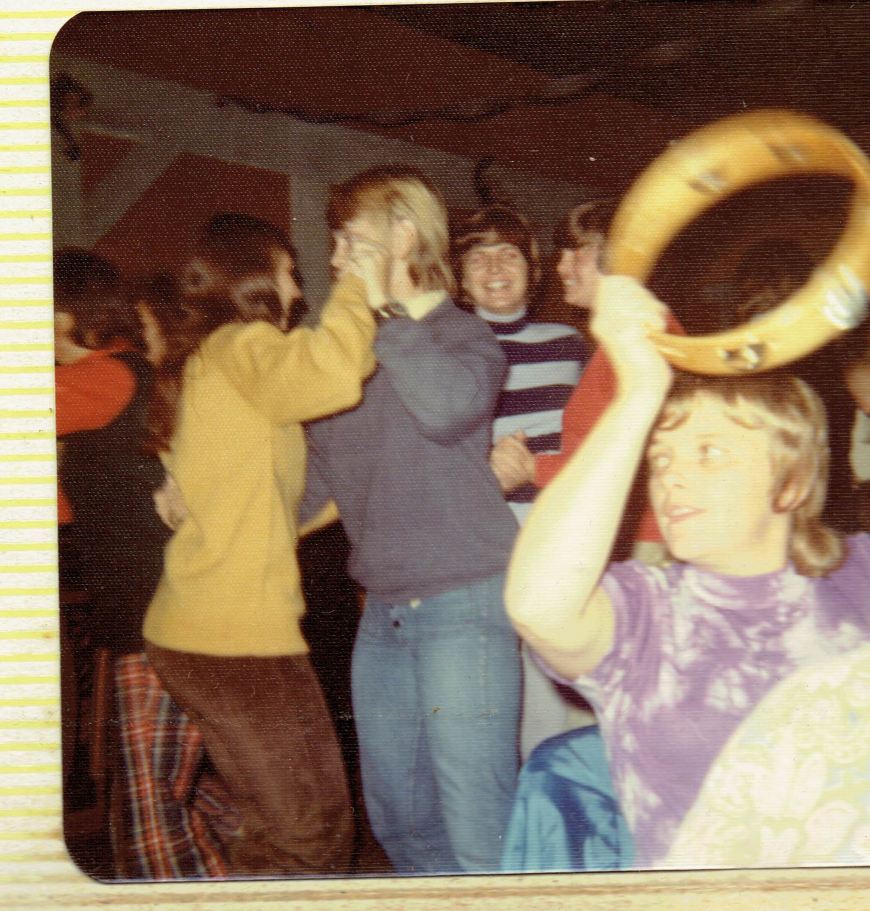
dancing at club03202015
the small dance floor at the Girls Club, (Michele Faucher photo album)

The clientele was diverse, though mostly white, ranging from regulars who had been going there for decades to “tourists” like those of us from SHL visiting from what seemed like a different planet. From my own experience in the military, there were probably WAF from nearby Westover Air Force Base in attendance as well. This was, as far as I know, the only lesbian bar in Western Massachusetts at the time, and one of the few in New England outside of Boston.

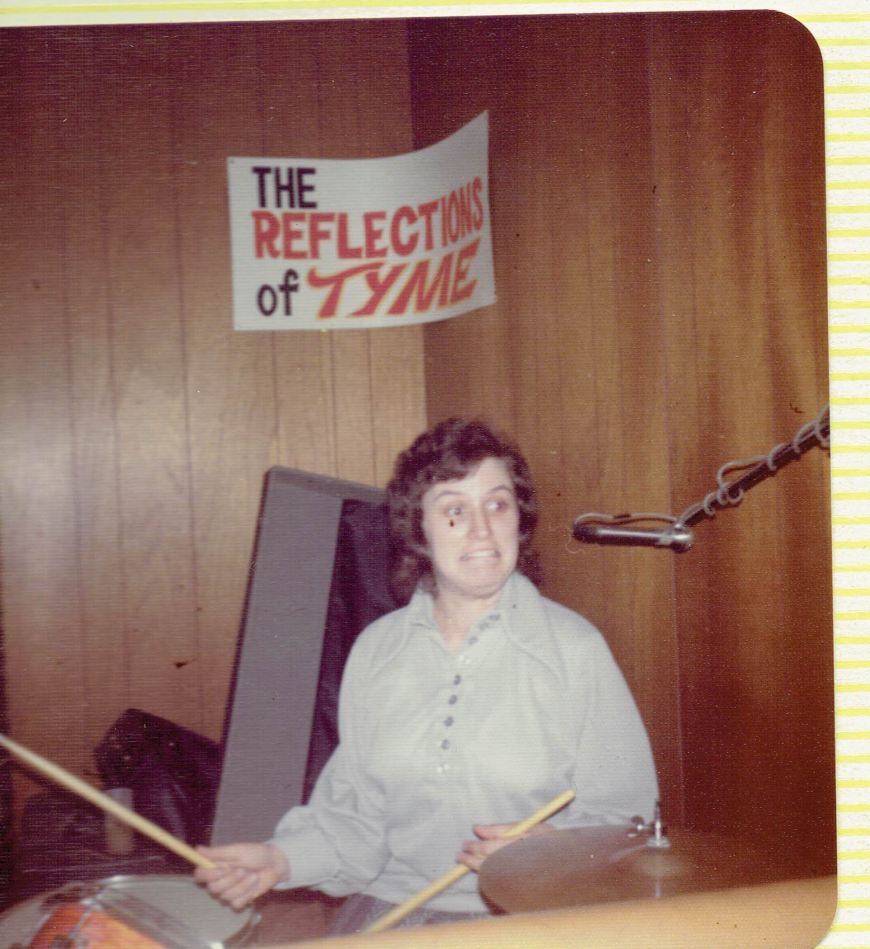
I later met someone who grew up in the area, the drummer Michele “Micki” Faucher, who played the Girls Club as part of an all-“girls” (as they were called back then) rock band the Reflections of Tyme. When not playing the Club, the band made music at weddings and other straight events as the Patches of Blue. I’m guessing that this was late 1960s to early 1970s.
micki the band at club03202015
Drummer Micki Faucher playing at the Girls Club with the Reflections of Tyme (sic) . (Michele Faucher photo album)
the band at club03202015
Reflections of Tyme playing at the Girls Club. (Michele Faucher photo album)
reflections of thyme03202015
The Patches of Blue, the band’s “straight” guise. (Michele Faucher photo album)

There is a fine novel by Sally Bellerose  called The Girls Club  (Bywater Books, 2011) which accurately includes this very same bar as a not so minor setting. Highly recommended.

Looking for: The names and whereabouts of the other band members, more of the Club’s history.  Recollections anyone? Please comment here or email me (see contact above).

Coming next: “T” is for…

Sources:

__Cercone, G. James. “Survey of 100 Homosexual Members of the University of Massachusetts Student Homophile League (April 1971). For a Sociology 391 Seminar. I only have the pie-chart graph from this.

__Rothenberg, Heather. “Our Hideaway: history and ‘herstory’ of a lesbian bar as a social institution.” Project Proposal. Smith College. September 1998. Project may not have been done, it included interviewing the bar’s owner who had retired to Florida.

__Faucher, Michele. Photo album undated given to Kaymarion Raymond.
It Started In Amherst


In the Connecticut River Valley, the Women’s and Gay Liberation Movements both began in Amherst. They soon spread to other communities, reaching a unique intersection in Northampton that marks the beginning of the town’s LGBTQ history. It all happened within the context of sweeping nationwide social change also focused around the counter-culture, anti-war, New Left and Black Nationalist movements, all which had local counterparts.

Though the first event of Valley Second Wave feminism may have been the appearance of WITCH at Smith College in 1968, the first group to form was Amherst Women’s Liberation in 1969. Four Amherst women found each other, and found four more, to form the first support (conscious raising) group and spread the word. Within a year, AWL had grown to a hundred women members meeting in support, study, and action groups, as well as in monthly forums. The groups met in the women’s homes and in church space.

In December 1970, AWL rented space over Pierce’s Art Store at 200 Main St. in Northampton and opened the Valley Women’s Center. VWC’s half of the second floor space, shared with a beauty parlor on the other side of the stairwell and entry hall, included a storefront-like drop-in space with couches, bulletin board, reading material, desk, phone, call log, mimeograph machine, as well as a second, smaller room used for counseling. The third floor open loft space was used for larger meetings, including the general membership meeting, and, at one point, a free store.

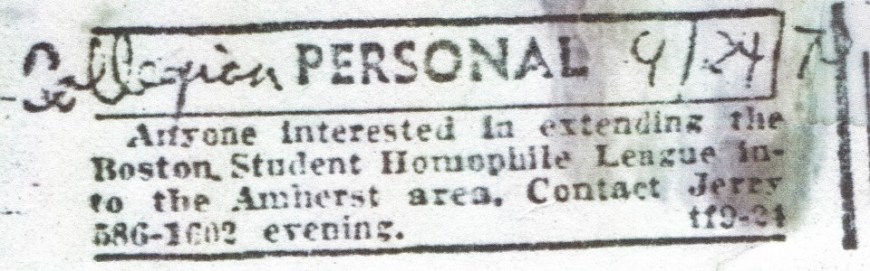
During the summer of 1970, my partner Susan heard about AWL and joined a support group. What interested me, however, was a personal ad I found in the UMass student newspaper, the Massachusetts Daily Collegian, when I returned to school that Fall as a sophomore: “Anyone interested in extending the Boston Student Homophile League into the Amherst area. Contact Jerry 586-1602.”

cropped-collegian-ad-197003202015_0001.jpg

Or some version of it, because by the time I saw it and called, Kathy had joined Jerry as another contact person. From my recollection of what she told me, after that initial ad and others, the group met in various places in Amherst, including a church, before settling to weekly booking of space at the Campus Center at UMass. The advertised names were pseudonyms for Michael Obligado and Kathryn Girard, both UMass grad students.

Again, a singular event is noted as the “first gay outing” in the Valley: Roz Shapiro and Cindy Shamban read lesbian poetry in their dorm corridor at UMass in 1968. The first political gay group in the Valley I’ve found evidence of is SHL. Students, mostly from UMass, were the majority of those who called the contact number for more information. Within a year, membership grew to a hundred, and included UMass faculty and staff, people from other colleges, and from local communities.

To protect the privacy of those who attended and prevent harassment (which could include violence), the meeting places were not publicized. Providing a safe space to meet and socialize was always a primary function of the UMass Student Homophile League, followed closely by a need for information on a wide range of issues and a place to discuss them. The group quickly added a public educational function. Members advocated for its right to exist and for change in public attitude and behavior toward gays. The pages of the student newspaper, particularly the letters to the editor section, became one forum for advocacy.

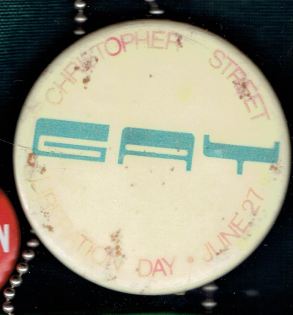
Attendance at the Second Christopher Street Liberation Day (June 1971) in New York City was a pinnacle of SHL’s first year, as reported here in SHL’s mimeographed newsletter The Closet Door that I wrote:

closet door sep 71 christopher03202015

christopher st 197103202015button gay revolution 197103202015

The Northampton meeting of these two streams of activism occurred the summer of 1971. Kathryn Girard and I had previously been invited to an AWL support group to lead a discussion on being gay. That led to an invitation to conduct a similar discussion at the monthly forum in July, attended by about fifty women. This was followed in August by AWL paying the registration fee for me and three other SHL women to attend the first New England Lesbian Feminist Conference in Kent, Connecticut. My secret lover was there with her other primary (and “public”) lover is what I remember most from that conference. Oh, and it was the first I heard of granola or slept on the hay in a barn.

Summer ended at the Tri-County Fair where Amherst Women’s Liberation got a booth and AWL’s Isabel Arnold invited SHL to share the space. That Fall these and other events were reported by me in the SHL’s first(?) newsletter The Closet Door, run off on AWL’s mimeograph machine, as was the flyer circulated at the Fair. I notice in rereading that newsletter that I still referred to us as “gay women” in spite of having just attended a Lesbian Feminist event and also used the pejorative diminutive in referring to Women’s “Lib.” The seeds of ideas were planted however.

closet door sep 71 more summer w AWL03202015

Coming Next: Checking out the women’s bar in Chicopee.
Sources:
____[Raymond], Kaymarion and Letalien, Jacqueline Elizabeth. The Valley Women’s Movement: A Herstorical Chronology 1968-1978. Northampton. Ceres Inc. 1978.
__Massachusetts Daily Collegian, coverage of SHL/GLF starting Sep.24,1970.
__The Closet Door, Student Homophile League, Sep. 1971.


1970s Overview: Lesbian Community Emerges


In the seventies a Lesbian (with an intentional capital “L”) community consciously emerged in Northampton out of the local Women’s Liberation Movement with an infusion from the Gay and perhaps other radical movements in the area. Largely invisible to the general public, the focus of activity was on creating what Lesbians needed specifically for themselves. Places and ways to be together were a first priority.

By 1976, five Lesbian spaces existed in town, each groundbreaking in its own way: a rooming house on Green Street, the Lesbian Gardens and Common Womon Club spaces that functioned as community centers, the Egg business cooperative, and the Nutcracker Suite karate dojo. Within these spaces, new activities, expanded communication, and cultural expression began. Many firsts included a restaurant, weekly coffeehouse night, newsletter, library, bookstore, publisher, and distribution of local lesbian music, writing, and art, as well as a variety of interest and support groups.

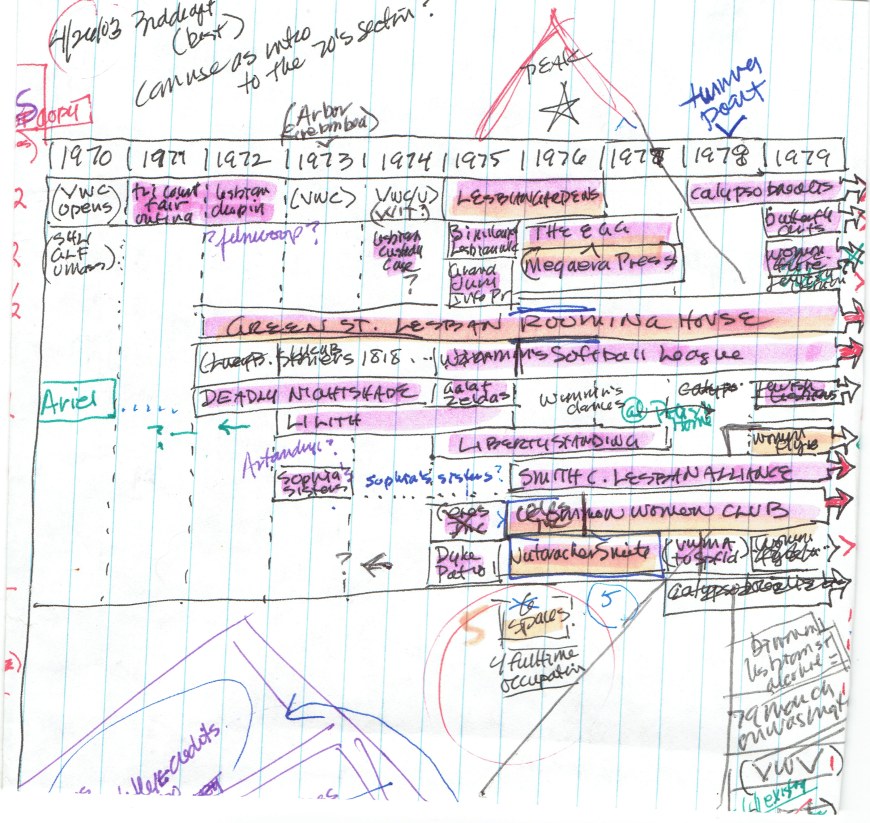
Each of these spaces will have their story included in future posts, as well as much more, and I welcome information and guest posts. The rough draft timeline below is just sort of a visual teaser, as well as a way for me to begin to organize the writing topically as well as sequentially.

1970s working timeline02132015
an early draft timeline trying to see some order in the decade.                      yes its incomplete . do you have info to add?

Efforts also took place this decade to expand the more traditional gay bar culture to town. Three all-women (lesbian) rock bands playing in the area helped spark a dancing boom. Lesbian space was temporarily obtained at two town bars, the Gala and Zelda’s, and larger spaces were occasionally rented for the new phenomena: wimmin’s (only) dances. Northampton lesbians also helped form what would become a countywide Wimmin’s Softball League. The odd spellings are a story in themselves of the radical reclamation of language.

Many of the initial community organizers were radicals, but there were differences among them in theory and practice. Though there were growing numbers of newly identified lesbians (politicized or not) at both of the spaces that served as community centers, some were excluded for political reasons or became alienated during clashes that came to be called the Separatist Wars. The new elements of a bar culture in town were to a degree more inclusive, with fewer issues to debate.

Though many Lesbians continued to be active in the feminist movement, little energy during this decade was devoted to external political change specifically for lesbians. Creating Lesbian or Wimmin’s space with its attendant culture, though largely hidden from public view, was in itself a form of political opposition to the mainstream norm. This coming out and unintentional visibility did not, however, go unnoticed. A fight for child custody, harassment and violence on the street, the FBI’s incursion into the community, and an eviction were all early warning signs of how society would resist change.

Coming Next: How it began.


A Faux Girl Scout…


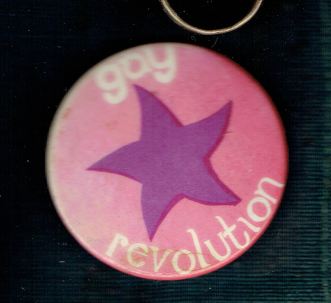
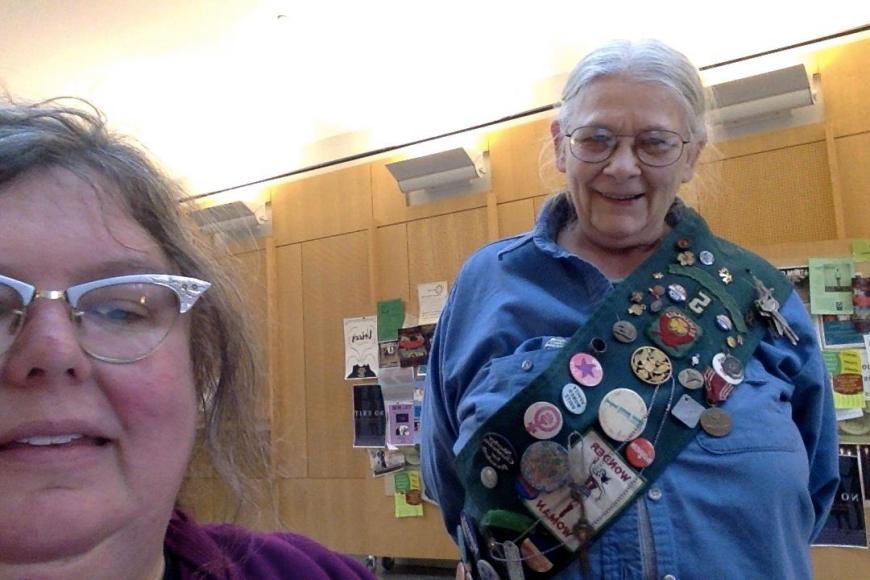
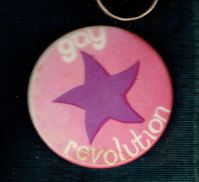
Susan Stinson had asked the source of the button I used to illustrate the last post. I explained that I had brought it back from the second (1971) Stonewall March in NYC and, for the blog, scanned it  in button gay revolution 197103202015situ_pinned to my faux Girl Scout badge sash. The dark green cloth is visible background. In response to her curiosity about the sash I brought it to show  at our most recent meeting. My wonderful writing coach asked to see it worn and appreciatively snapped the photo below.

The faux sash was custom sewn for me by Marguerite “Peggy” Cookson. We were both living at Green St. in the mid-late 70s and I had begun to organize my overflow of papers into scrapbooks. There were a significant number of objects that rubber cement wouldn’t work on. Having once been a Girl Scout I re-imagined the traditional badge sash as a larger life reflection .

As Susan said in her original post of it on facebook, “Kaymarion Raymond wearing the most amazing Girl Scout sash ever, covered with tokens and buttons from her adventurous life, including all sorts of old political buttons, feminist and presidential, both; her dog tags; keys from the old boarding house on Green Street and many other very cool items. We were meeting to go over work on her history of queers in the Valley. She’s got great stuff coming up.”

girlscout sash by susan

Thank you Susan. I note that mysteriously, to me, her computer camera takes reversed pix. And speaking of stuff, coming soon will be an overview of the 1970s in Lesbian and Gay Northampton with a hot pink timeline that also caught her eye. Smile.


Throw Back Halloween


I am just starting to draft copy about the many women’s bands that played in Northampton in the 1970s and came across this Halloween at the Rusty Scupper in Amherst where the Deadly Nightshade was playing. That’s me in drag, sitting with Liz Knowles and Nancy Schroeder. Photo courtesy of Pamela Brandt of the Deadlies.

km halloweenrusty scupper,w l knowles, DNS n schroede 10222015