Bars and the Violent Backlash


Being a small town may have spared Northampton the particularly virulent backlash that began to be experienced in the 1970s by feminist, lesbian and gay organizations in large cities. Bars, conferences, centers, publications and presses across the country had begun to be subjected to sniping, break-ins, vandalizing and arson.  The nearest incident was the Springfield firebombing of the Arch bar in 1973, which may have been Mafia related, but the Boston offices of Gay Community News were burglarized in the 70s before being destroyed by arson in 1982. Northampton, however, wasn’t totally spared a violent reaction to the new lesbian visibility.

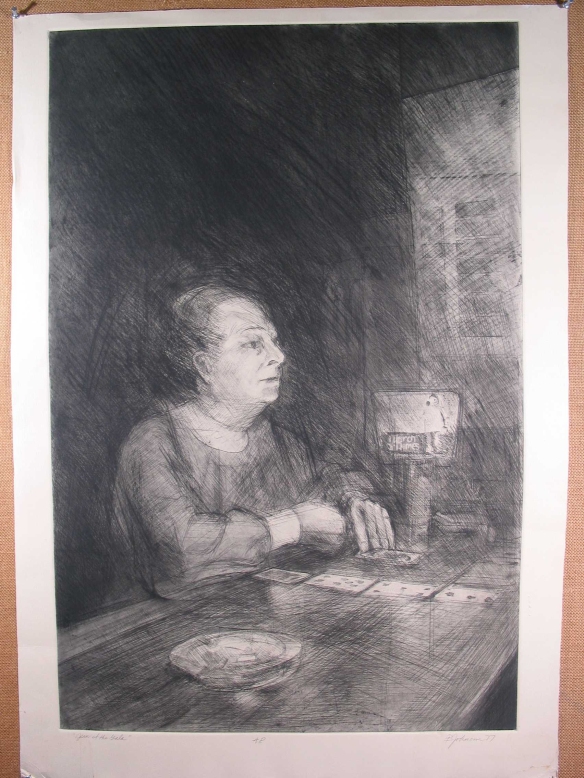
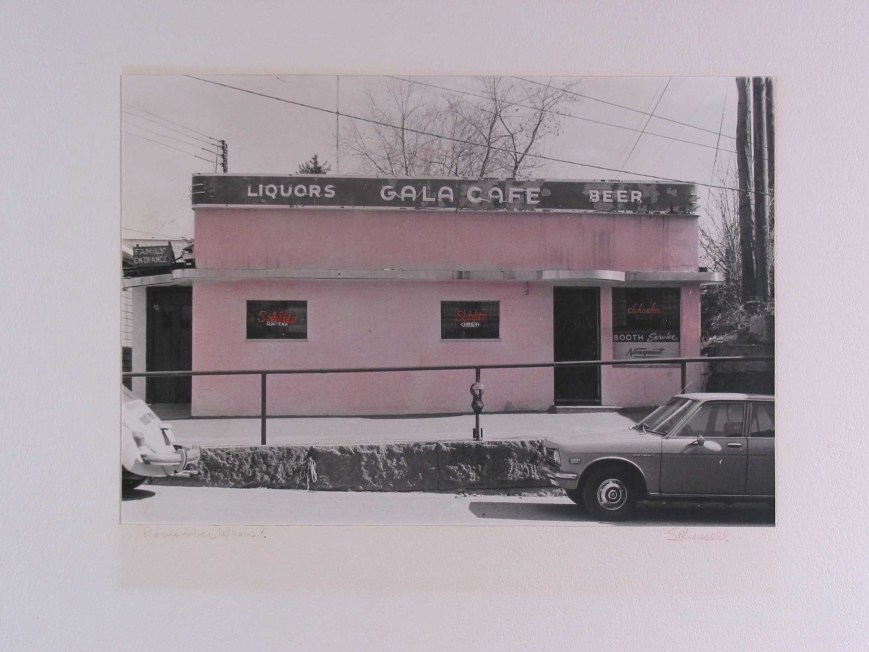
One response of the growing number of lesbians that began to come out in 1975 was to find local bar space rather than travel to Springfield or Chicopee. Jeanie, owner of the Gala Cafe on Bridge Street, was amenable to hosting women in the bar’s backroom once a week and discouraging men from intruding there. The bar with blinking neon lights was a small, squat pink stucco building between the railroad overpass and Jack August’s restaurant. The backroom, which may have once been for family dining, held a jukebox and booths squeezed round a dance floor.
 

jean gala
“Jean at the Gala.” 24”x36” etching by Barbara Johnson. Used by permission of the artist.


When the first lesbian disc jockeys began to spin records there, the place soon became packed, attracting many more gay women than just those who were politically active in town. This custom was to continue through 1979. Because the Gala was so small, in the summer of 1975, the larger backroom of Packards on Masonic Street was rented for “Wednesday Nights at Zelda’s.”
 

gala cafe_edited-1
“Remember When?” Handtinted photo by Sandra Leigh Russell. Used by permission of the photographer.


Over the summer of 1975, there was greatly increased visibility of lesbians on Northampton streets several nights a week. Women leaving these neighborhood bars began to be taunted by men. Rumor had it that several weeks of harassment culminated in a lesbian being attacked outside the Gala by several men armed with a shovel and a machete. The rape of a lesbian who was walking home from the bar was also rumored. (I am still seeking substantiation. Without it, I can’t verify these incidents.)

Responding to the increasing frequency of such incidents, Lesbians formed a Community Education and Self-defense Group in August of 1975 that organized small groups of women which became known as the Dyke Patrol. They established a physical presence outside the two bars, Lesbian Gardens and the occasional Wimmin’s dance, and also escorted women to their parked cars. This seems to have worked as an immediate deterrent, for the Patrol was disbanded six months later. It was, however the beginning of a violent male pushback on the streets of Northampton that would escalate over the next decade as Lesbians, and then Gay men, insisted on a new visibility in the City.

The Gala Café was razed in 1983 along with Jack August’s, the restaurant next door, to make way for a sports bar.


SOURCES:

  __[Raymond], Kaymarion and Letalien, Jacqueline, editors. the Valley Women’s Movement: A Herstorical Chronology 1968-1978. Ceres Inc. Northampton. 1978. Valley Women's History Collaborative

__Old South St. Study Group. “Analysis of a Lesbian Community-Part One.” Lesbian Connection. Jul 1977. P7-8.

__Potter, Clare. The lesbian periodicals index. Naiad Press. Tallahassee FL. 1986.               Listed, between 1973-1979: Sniper shot at women convening in Seattle; Gay Community News (Boston) and Majority Report (NY) offices burglarized; A NYC women’s center vandalized; St. Louis Women’s Center and Iowa Clinic firebombed; Fires also set at the Los Angeles MCC Church, Seattle Gay Community Center and a St. Louis bar.

__Mitchell, Phoebe. “Last Call for a Bar Ahead of Its Time.” Daily Hampshire Gazette. July 07, 2004. Northampton MA.
Did the FBI Come To Town?


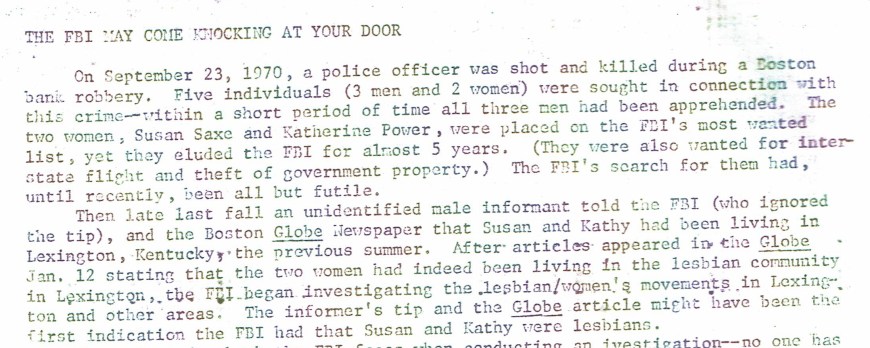
In early 1975, Northampton lesbians began to see and hear about strange men in town taking photographs and recording license plate numbers. At least one lesbian home was mysteriously broken into. Many in the Northampton lesbian community feared that the community was under scrutiny by the FBI.

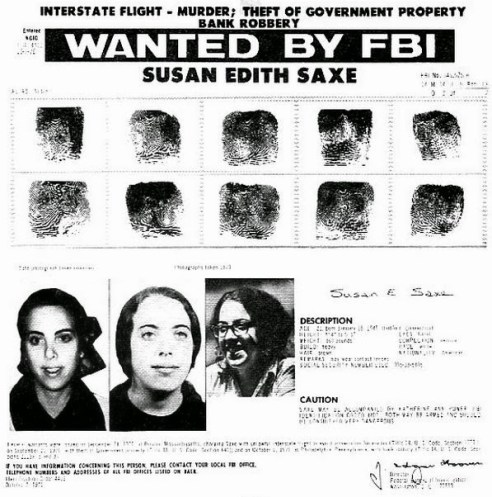
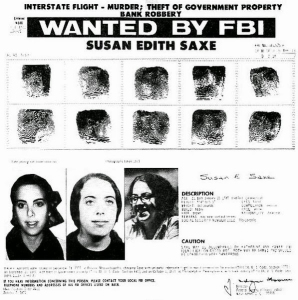
Already that year, at least seven lesbian/women’s communities nationwide were being investigated by the Federal Bureau of Investigation, in hand with Federal Grand Juries, ostensibly to track down Weather Underground fugitives Susan Saxe and Kathy Power.  Warnings spread through alternative media, including the hand-stapled, mimeographed Lesbian Connection that had begun to be read in Northampton’s Lesbian Community. Here’s an excerpt from the May 1975 issue:

LCMay 1975_edited-1


Susan_Saxe_Feminist_FBI

Across the country, those refusing to talk to FBI agents were often subpoenaed to appear before a Grand Jury. Anyone who  continued to fail to cooperate was jailed indefinitely for “contempt.” Even after Saxe was arrested in Philadelphia in March of 1975, radical news media reported that investigations had been expanded and, nationwide, at least seven lesbians and one gay man were imprisoned for their silence.

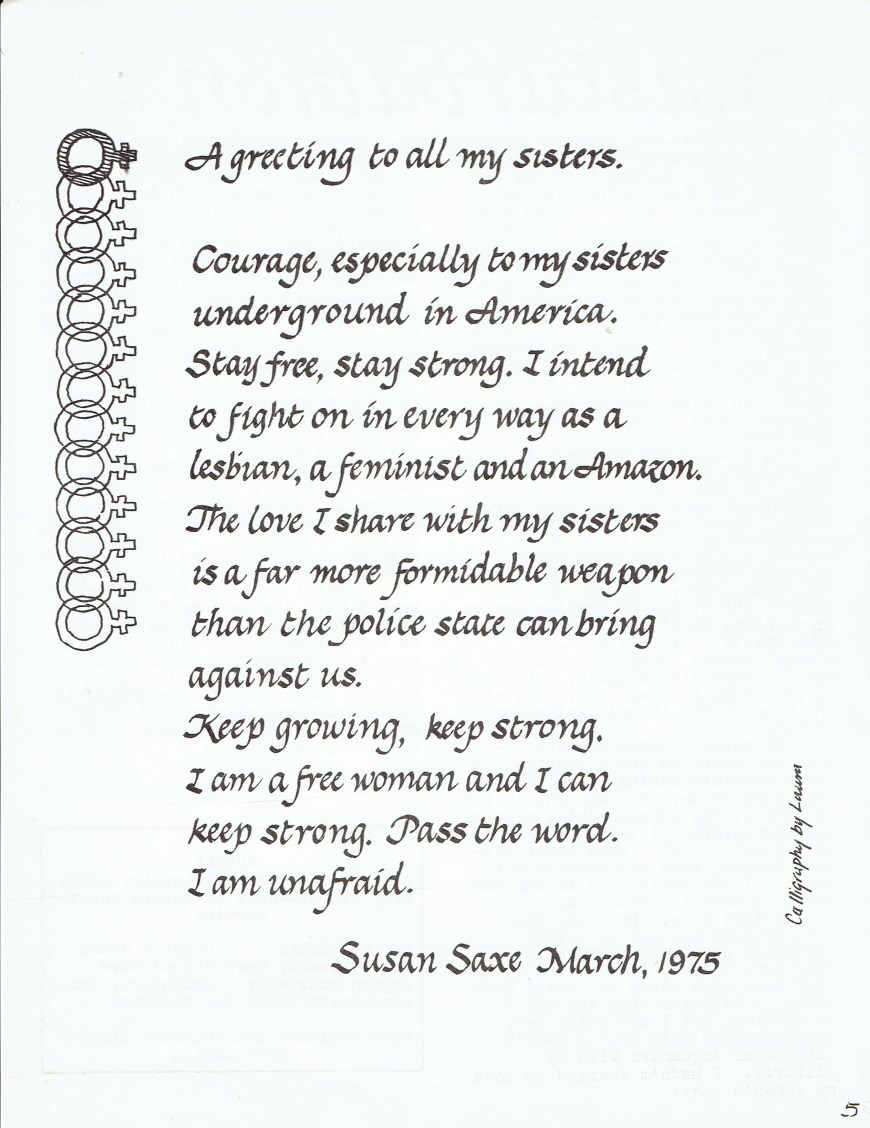
Saxe’s letter after her arrest was circulated nationwide. It was published in Northampton in Old Maid, Lesbian Gardens’ first publication, Spring 1975.

old maid spr 75 saxe letter_edited-1
calligraphy by laura kaye


Many feared the Government was attempting to infiltrate and destroy the Lesbian/Women’s Movement as it was doing to other progressive groups. Fear of being outed as lesbian or gay, or loss of child custody by single mothers, was being exploited in these “fishing” expeditions. According to reports in radical media, the questions being asked included details about others, not only their names and roommates but also their political and sexual activity, bars visited, meetings attended, who else was there and the content of discussions.

In this climate, a local Grand Jury Information Project was begun in May 1975 in Northampton. It was a cooperative effort housed at the Northampton Women’s Law Collective on Main Street with volunteers, as well, from the Valley Women’s Union, Springfield Women’s Union and UMass Everywoman’s Center.

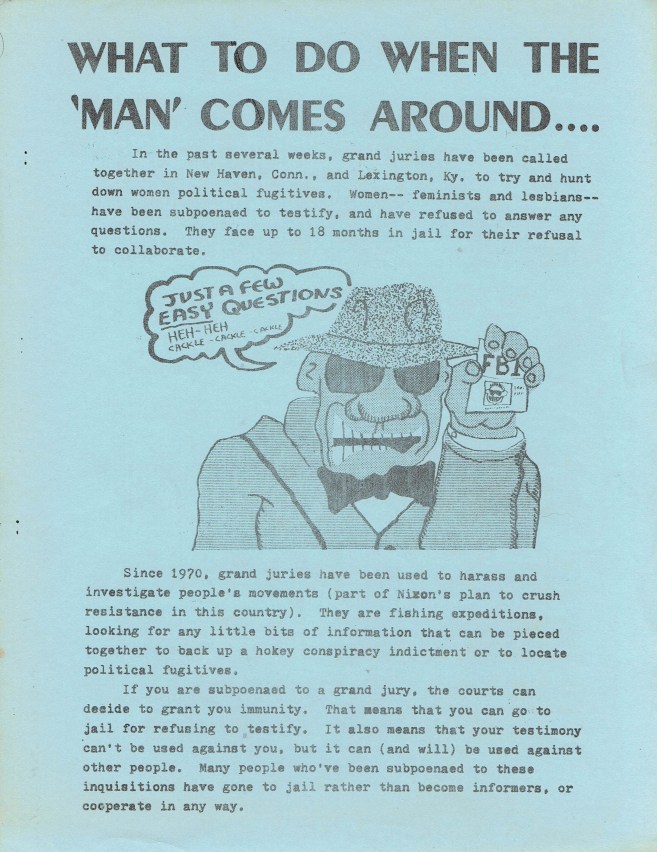
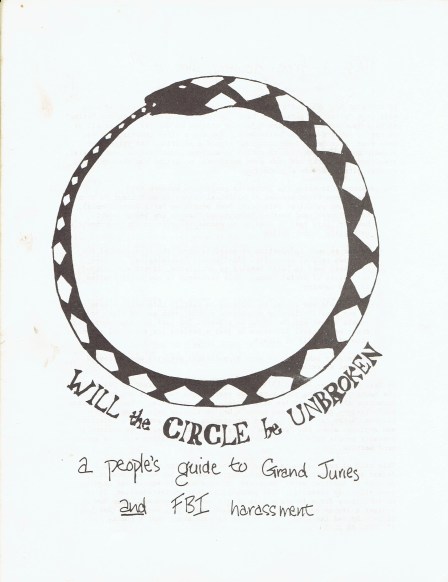
Over a four month period, the Project did rumor control in the Valley and circulated printed material at events and information meetings on FBI and Grand Jury abuses and individual legal rights, including the right not to talk to investigators. As awareness spread, local lesbians and feminists began to take precautions, educating housemates and neighbors, and reporting suspicious behavior to the Project. Some feminist therapists and counselors went so far as to destroy or otherwise secure client records to further protect confidentiality.

FBI info_edited-1

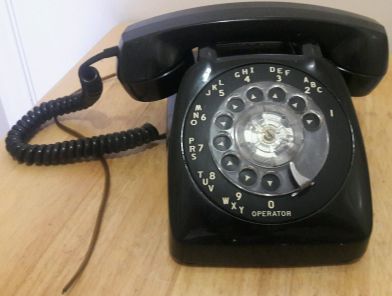
The increasing paranoia had a humorous side. Peggy Cookson recalls that lesbians at Green Street took apart their MaBell black bakelite telephone handsets to cut out suspicious looking little green phone components thinking they were ”bugs” (recording devices). The resulting increase in static was taken as confirmation that the phone lines were indeed being tapped, rather than that the green bits were actually anti-static devices.bakelite phone

At the end of summer, tension was eased a bit when a Northampton Lesbian issued a letter to the community stating she had been subpoenaed and appeared before a Grand Jury in New York. She said she had refused to answer any questions and the queries seemed to be connected to her past involvement with Irish politics and not focused on lesbians. Though this investigation appeared to focus on an individual, it was only the first of several attempts by the authorities to gain information about local lesbians and the community in order to identify “subversive” elements.

grand jury info_edited-1
pamphlet from the new york city grand jury information project, circulated in the valley

SOURCES:

__ [Raymond], Kaymarion and Letalien, Jacqueline, editors. “A Herstorical Chronology of the Valley Women’s Movement 1968-1978. Ceres Inc. Northampton. 1978.

__Old Maid.  Northampton. Spring 1975.

__Grand Jury Information Project. Flyer. July 16, 1975.

__”Remember Grand Juries?” Quash: Newsletter of the Grand Jury Project. May-June 1977.

__Ann McCord. Remarks to author about client records. Ann was a counselor at Everywoman’s Center and member of the Feminist Counselors’ Collective.


Dancing Wimmin: Lilith, the band


Dances for “wimmin only” became accepted events in the Valley as Lesbians were increasingly active in the Women’s Liberation Movement and, starting in 1974, began to create space for ourselves. They were very special events when the music was performed live by women’s bands.  First the Deadly Nightshade and, then, Lilith provided the sound track for bashes and benefits.

I informally interviewed Lilith founder Beth Caurant for the first time in 1998 at her home in Northampton. She generously provided a written personal remembrance and some photographs of the band. In 2004 she commented on a brief draft by me of the band’s history. In 2015, when I started the blog, I sent her a dusty post draft that prompted her to write more. In the meantime she had been interviewed for JD Doyle’s Queer Music Heritage  radio show broadcast in 2007, with many documents as well as music recordings made available online. This brief account of Lilith  draws on these multiple sources.

Lilith founder Beth Caurant recollects that in the early 1970s it was unthinkable to play music professionally without having men in the band. “You could be a lead singer or perhaps a folk duo, but it was assumed that only men could play the drums or electric instruments.” One evening when she was having dinner in a restaurant in Amherst, she heard the Deadly Nightshade play for the first time, “Three women playing together without men— and they sounded great!”

Inspired to look for other women who might want to form a rock band with her, she went to the Valley Women’s Center in Northampton to put up a notice. She found one from two other lesbians already posted:”Looking to jam, play some music and drink a little wine.” She called them immediately and they did just that. “We all played guitar and sang, with beautiful harmonics, and one who could sing lead vocals. We decided on ‘Lilith’ as a name, as the woman who defied Adam.”

Their first gig, with a very limited repertoire, was in 1973 at a lesbian party in Wendell. For a year they rented a house together on Perkins Avenue in Northampton, gradually adding other musicians. Because there were so few female rock musicians, they became a band of whatever combination of vocalists/players were interested at the time. A clarinet player was added because she was willing to eventually play the saxophone that the band really wanted, but she wouldn’t join without her girlfriend, so a keyboard was added as well. At one point, when they needed a bass guitar, Beth’s girlfriend Tatty Hodge learned to play one from scratch.

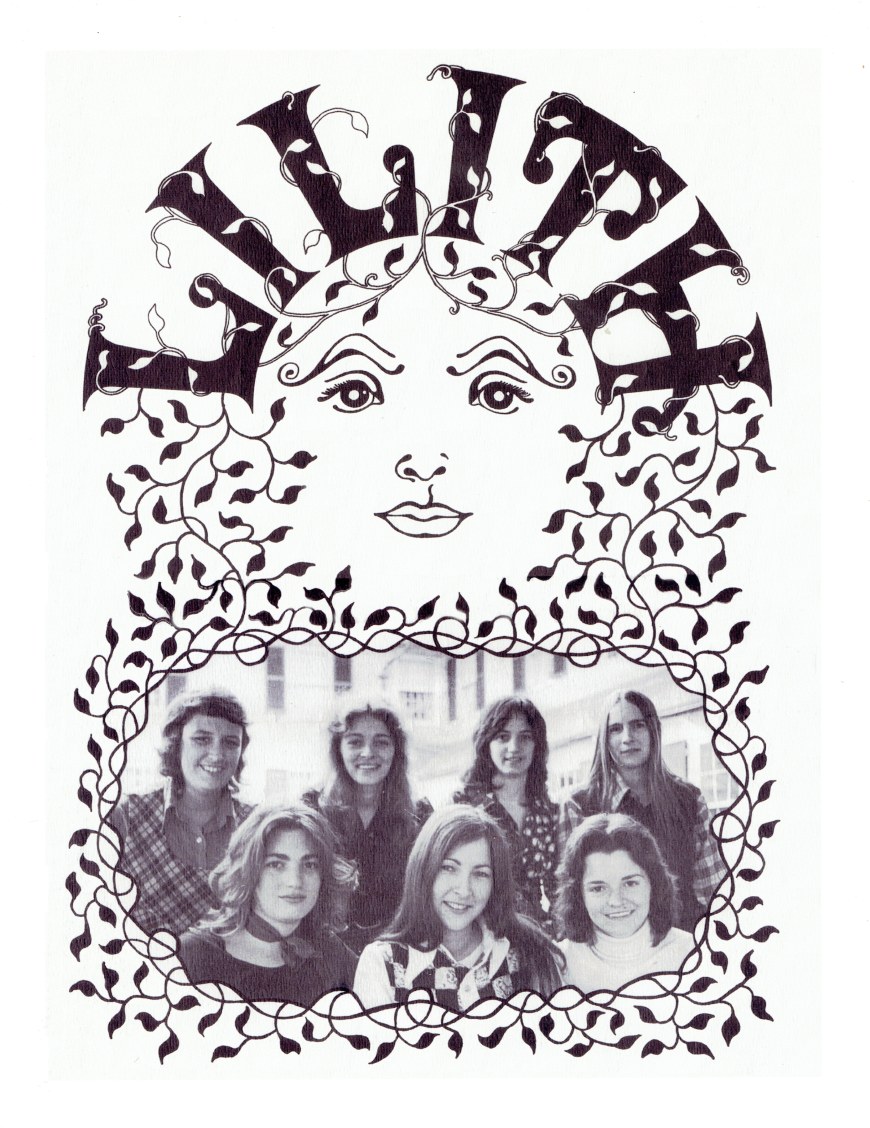
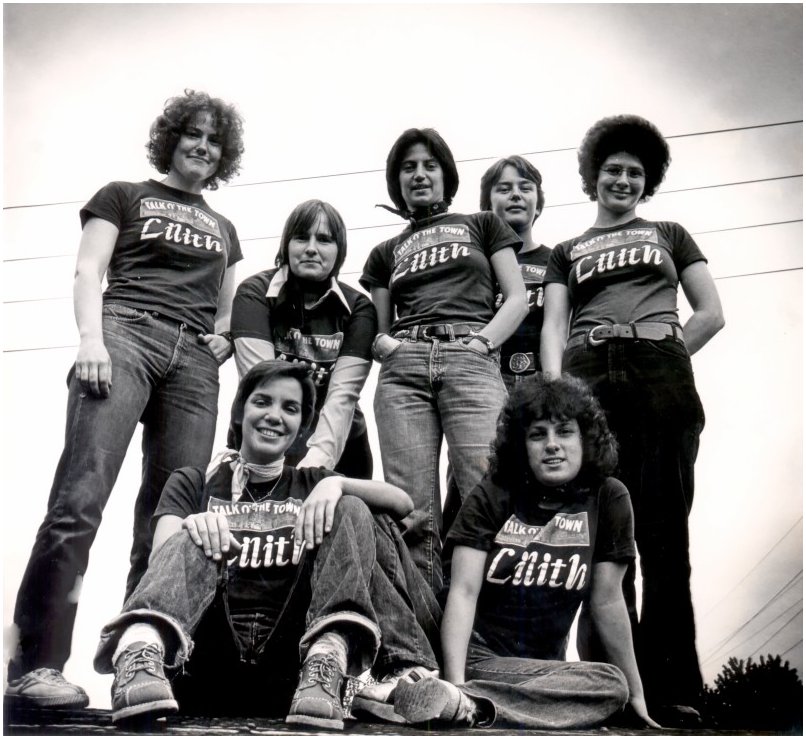
lilith first poster10222015
First Lilith poster. Back row left to right: Micki Faucher, drummer; Claire Frances, lead vocals; Beth Caurant, guitar and vocals; Peg Brewer, keyboard. Front row left to right: Belinda Star, vocals and guitar; Liz Knowles, saxophone; Tatty Hodge, bass. (Courtesy Beth Caurant)

Beth has written that they were also very young and into the drinking, pot-smoking bar scene. By the time they cut their LP in 1978, Lilith had grown from a trio to a seven-member band and gone through thirty personnel changes, with only two of the original members remaining. In spite of internal chaos, Beth recalls that when the band’s playing was tight, it was really exciting.

At the beginning of their career, Lilith played for women’s dances at Smith and Mt. Holyoke Colleges. Valley women were treated to double the dance when both Lilith and the Deadly Nightshade played a benefit dance at UMass in 1974. Lilith played many of the same venues in the Valley as the Deadlies including the Vermont  Bernardston Inn, but they also played Springfield’s gay Frontier Lounge and Arbor.

lilith business card10222015

Most of the performance venues available, however, were straight bars and dance clubs. The band played repeatedly at The Rusty Nail in Hadley. Lilith became regulars at two Pleasant Street establishments in Northampton: the Saint Regis, a restaurant with a large dance room; and the Lazy River. At both places, the band drew a large following of local lesbians who mixed in with the other clientele without a problem, according to Beth.

Beth still remembers, however, that this practice of playing for lesbians at straight clubs and playing music by men (for its dance-ability) drew comment from one Northampton Lesbian Separatist, at least in fictional form. In her 1976 collection of poetry and short fiction They Will Know Me By My Teeth, Elana Dykewoman included a short story entitled, “Without Love”, which was the name of a Doobie Brothers song that Lilith covered. In the fictional account, a woman who lives down the street from a bar hears a women’s band play mostly men’s music where a “cluster” of lesbians dance. The women, the story implies, are trying to pretend that the men in the bar aren’t watching them, identifying them as lesbians, and preparing to stalk them when they leave the bar. This fiction reflects the history of increasing violence against lesbians in Northampton starting in 1975 as they became more visible in bars and on the streets and the issues being raised by local Lesbian Separatists.[More on these issues in future posts.]

Safer, more comfortable women-only venues were rare but welcome opportunities for women to gather and dance. Very early in their career, Lilith played at a private party at the Northampton Colonial Hilton thrown by a Smith College residential house. Such resources were most available to campus groups in the Valley. One of the largest women’s dances may have happened when Lilith played at a packed Blue Wall Cafe for the 1975 University Women’s Conference at UMass. The first of these live band wimmin-only dances for Northampton townies may not have occurred, however, until 1977.

With time, the band enlarged their playing circuit outside the Valley to include Boston.  At the beginning of 1975, they provided the music for newly elected state representative Elaine Noble’s  inaugural ball. She was the first openly gay candidate in the country to win a state office, representing Boston’s Fenway and Back Bay neighborhoods in the Massachusetts Legislature for two terms.

Elaine Noble ( http://www.wgbh.org/articles/A-Portrait-of-Elaine-Noble-8182)
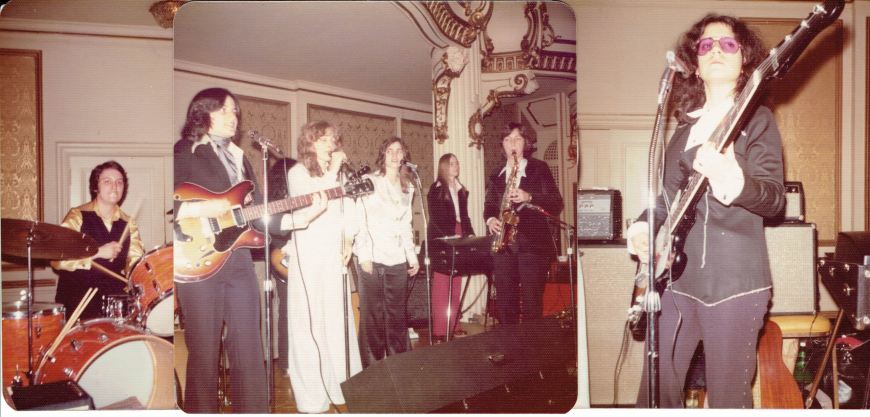
Noble inaug lilith03032016
Lilith playing at Elaine Noble’s Inauguration Ball. From left to right: Micki Faucher, Beth Caurant, Claire Frances, Belinda Star, Peg Brewer, Liz Knowles, Joy Barone. (Photos courtesy Michele Faucher.)

The band also played a Susan Saxe  Defense Fund benefit in Boston at the Saints, a lesbian bar where they frequently played. Saxe was arrested in 1975 for alleged participation in a 1970 Weather Underground robberies of a Massachusetts armory and a bank, which involved the shooting death of a bank guard.

Susan_Saxe_Feminist_FBI

After her capture and arrest in Philadelphia, Saxe came out in feminist media as a lesbian and appealed to her “sisters” for support. Feminists and lesbians across the country did support her, including in the Valley, raising funds for her legal defense. After the Saints benefit in Boston, Beth Caurant believes the band came under investigation by the FBI. She says that men were seen taking photographs of her car and house and agents questioned her landlord about the band.

In 1975, Lilith cut a single demo 45rpm record, covers of Van Morrison’s “Moondance” and Jean Knight’s “Mr. Big Stuff”, to begin to promote themselves. Starting in 1976 the band began to get some critical mainstream press as they took their rock, soul, and swing north into Maine and south to Rhode Island and points in between.

Lilith Photos 75-76 Northampton
Lilith 1975-76. Back: Lou Crimmins, Peg Brewer, Beth Caurant, Myanna Pontopidan, Kathy Piccus. Front: Lynn O’Neill, Joy Barone. Photo courtesy Beth Caurant.

A newspaper review of their appearances in Hartford CT described them warming up the crowd with “Reggae Woman” disco-soul sound; moving more people onto the dance floor with “Money,” a pure disco sound, hard and bright; then to their cover of “Mr. Big Stuff.” Dancers rested while Joy Barone did a Janis Joplin–like “Total Blues,” then Marianna on sax surrounded Cathy and Lou’s vocals to send folks back up to the dance floor to bump and hustle. Reviewer Susan Rand Brown concluded in the Hartford Advocate, “Lilith is a whole band of rock musicians really doing it.”

Lilith spent the early six months of 1977 on an experimental southern tour. They embarked without a bassist or drummer, so they had to fill in along the way: Debbie Campbell, bass; Laurel Blanchard, drums. They added a new vocalist as well, Janice Warner. When they returned north, they settled in the Boston area with another new sound. The band that once again played at the Rusty Nail in Hadley was described by a male reviewer as “a middling-fair bar band playing cover versions of Stevie Wonder, bump and boogie of Wild Cherry, Pick Up the Pieces funk and the occasional ballad.” The Springfield Morning Union reviewer did note two original pieces, and wrote that the dance floor was two-thirds occupied by women couples.

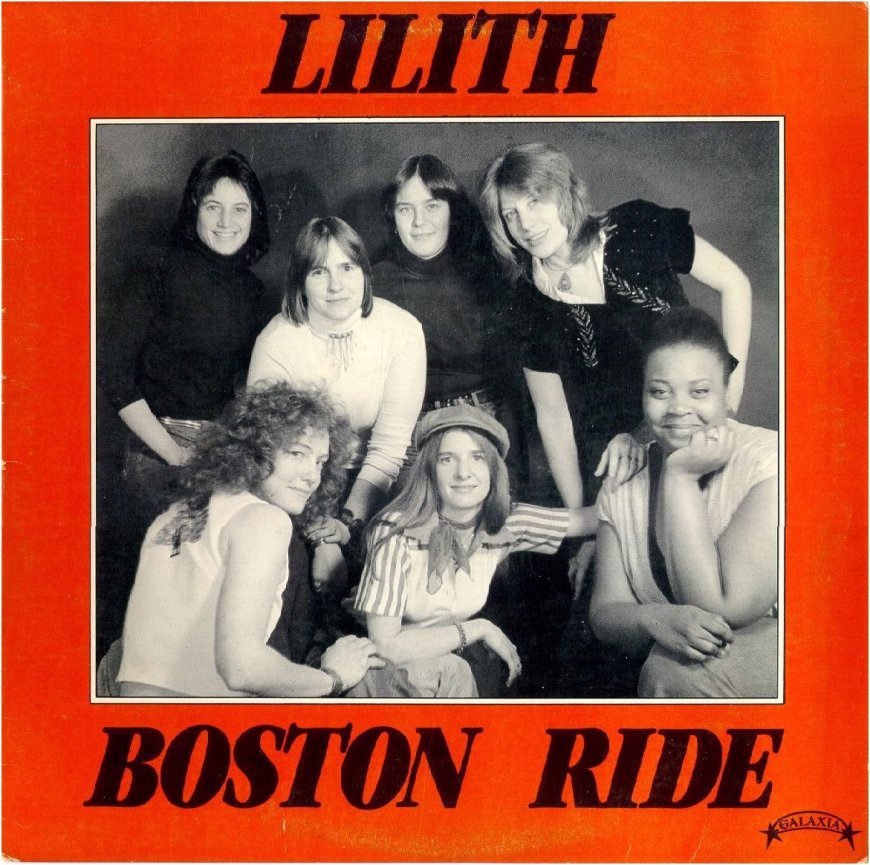
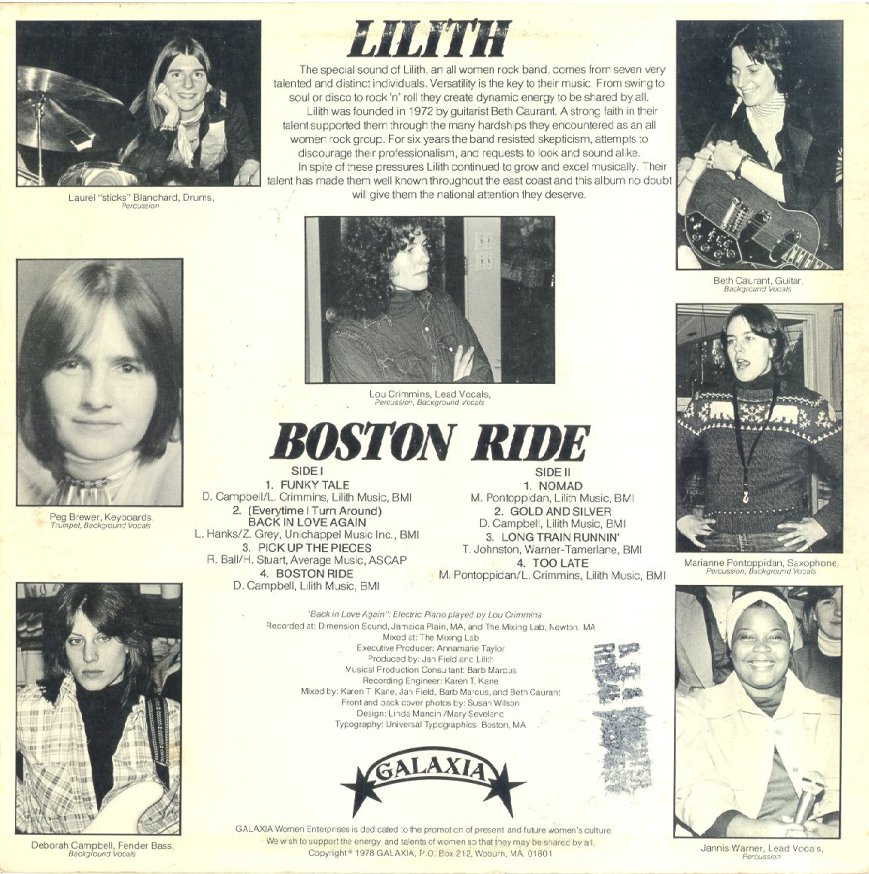
In 1978, they released their first LP, “Boston Ride,” under the new Galaxia label. Two–thirds of the album was original music. The album was well received. Reviews made the mainstream as well as alternative press.

LilithLPf

LilithLPb

Despite high points such as opening for Bonnie Riatt, and good sales of the album, even in Europe, the high energy group couldn’t stay together past 1978. Karen Kane, the “Boston Ride” engineer, commented in a 2009 interview. ”The band (Lilith) dynamics were very hard and Beth and I basically mixed that album and made it happen. And now I listen to it and it’s like, hmmm, not too bad for 1978. You know it helped them, for a while, with their career, but they were having such terrible band dynamics that they didn’t last, unfortunately.”

Beth Caurant has still kept herself in music with women, a little bit, over the years. Most recently she appeared with the Girl Gang at Luthiers in Easthampton. After their show, she remarked to me on the number of old Lilith fans who attended and commented fondly on those old times that women danced together to music by women.

SOURCES:

__Caurant, Beth. Interviewed by Kaymarion Raymond, handwritten notes. Jan. 6, 1998.

__Caurant, Beth. Untitled [Lilith remembrance to Kaymarion private file.] Jan. 4, 1998.

__[Raymond,} Kaymarion and Letalien, Jacqueline, editors. The Valley Women’s Movement: A Herstorical Chronology 1968-1978. Ceres Inc. Northampton. 1978. Add linkMORE

__Caurant, Beth. Email correspondence with Kaymarion. May 14-30, 2004 and Nov 21-28, 2015.

__Nachman [Nachmon], Elana. They Will Know Me By My Teeth: stories and poems of lesbian struggle, celebration, and survival. Megaera Press. Northampton MA. 1976.
__Brown, Susan Rand. “Lilith: Rock and Role.” Hartford (CT) Advocate. Feb. 11, 1976.

__Danckert, Peter. “Lilith: Hunting Identity.” Morning Union, Springfield MA. Jul 29, 1977.

__Kane, Karen. Interview Queer Music Heritage.

May 2009.http://queermusicheritage.com/may2009s.html

__To hear some of Lilith’s music, read clippings, listen or read more of their history through an interview of Beth Caurant on Queer Music Heritage by JD Doyle follow these links below;

__Radio interview with Beth Caurant March 2007 by JD Doyle

http://www.queermusicheritage.com/mar2007.html

__ Transcript of Radio interview with Beth Caurant  http://www.queermusicheritage.com/mar2007s.html

__Elaine Noble. http://outhistory.org/exhibits/show/out-and-elected/1970s/elaine-noble

Beginning to Create Lesbian Space 1974-75


The Valley Women’s Center was at 200 Main Street in Northampton. In 1974 the Center reorganized itself along socialist feminist lines into a union: Valley Women’s Union (VWU). When a coordinating board was formed to represent the various enterprises and action groups* comprising the VWU, Lesbians asked for and were given an at-large seat. While very present in various activities Lesbians did not yet have a formal group, but shortly after getting a seat on the board  a Lesbian Issues Discussion Group formed. It met weekly, and grew to include thirty to forty women, mostly lesbians, some of whom hadn’t previously been part of VWU.

In May of 1974, the CLIT (Collective Lesbian International Terrors) Papers were circulating nationally. Initially, the CLIT Collective called for lesbians to withhold their energy from straight media, which continued to define and co-opt lesbians. The Collective advocated the creation of a separate Lesbian media. The idea was further expanded to mean withdrawing from the straight world as much as possible, including straight feminists, and creating a separate Lesbian community and culture.

CLIT intro para OOB May 75
CLIT Papers opening paragraph from Off Our Backs May 1974

The CLIT Papers, by a NYC group, caused a furor in feminist communities from coast to coast, including the feminist community in Northampton. They resonated particularly with Lesbians such as myself, who had devoted a lot of energy to women’s issues, but whose needs as lesbians were largely unrecognized. As a result of this new thinking some VWU Lesbians wrote a position paper asking for separate space at 200 Main Street. They began scheduling Lesbian-only events in the third-floor general meeting room, calling it “Lesbian Gardens.”

Increasing numbers of Lesbians began to identify themselves with this radical thinking and literally spelled it out. The different usage of lesbian (lower case) as a sexual identity and Lesbian (capitalized) as a political identity began to appear. If you see it here it is as carefully deliberate reflection of how it began to appear in local Lesbian writing and publications starting in 1974.

While still a student at UMass I helped start Everywoman’s Center, housed initially in 1972 in one large room in Munson Annex. In the beginning we pretty much invented our jobs, even as volunteers, and I wound up coordinating publications (a newsletter) and educational programming. We had inherited a workshop program for women designed to encourage continuing education, Project S.E.L.F. and in one of the first series Cindy Shamban and I co-facilitated a four week workshop in 1972 called “the Woman-Identified Woman.”  The topic and title came from a 1970 position paper by NYC Radicalesbians which I found and brought back from the second Christopher Street Liberation March. This may have been the first such offering in the Valley.

After I graduated from UMass I continued to work at Everywoman’s Center as paid part time staff with no benefits. The eight week long workshop program was one of my main responsibilities and  continued to be for several years, growing to an attendance of 350-400 women enrolled every semester, half of them non-students. Every semester I was able to include at least one with lesbian focus. The most popular was Julia Demmin’s “Lesbians in Literature,” which she offered numerous times, often with her partner Nancy Schroeder.

1975 began with the last program I coordinated for Everywoman’s Center, what may have been the largest gathering up to that time of Valley women, a week long University (UMass) Women’s Conference in Amherst attended by over 700 students, staff, faculty and community women. It also included the largest gathering of lesbians, more than sixty, who attended one or more of the three lesbian workshops.

75 womens conf

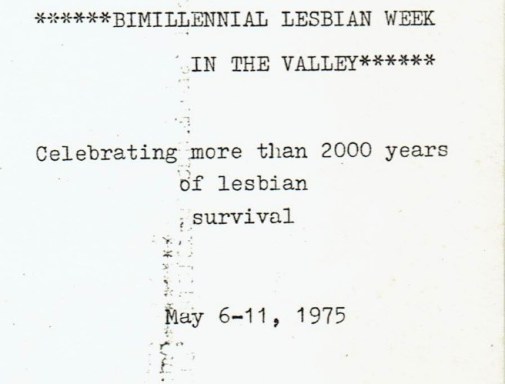
At the end of the conference, energized by this response, planning began for a similar conference for Lesbians in a collaboration of the UMass Gay Women’s Caucus; Lesbian Gardens; and UMass, Springfield, and Northampton women’s centers. The BiMillenial Lesbian Week was held in May 1975 with events in Springfield, Amherst and Northampton, culminating in a weekend retreat in Cummington which I attended. “BiMillenial” referred to two thousand years of Lesbian culture since Sappho.

BiMi ihead CCI_000027

CCI_000029


This happening, as we used to say, was advertised in Lesbian Gardens’ first publication. Old Maid: the Lesbian Magazine. The BiMillennial Lesbian Week marked the beginning of a proliferation of Lesbian activities. An increasing number of these took place at Lesbian Gardens, including a Saturday Night Coffeehouse with music by Lou Crimmins and other local musicians, the showing of the first U.S. Lesbian-made films, the formation of the Magical Lesbian Playgroup (a mother-daughter group?) , and the convening of the first Skills Exchanges and Winter Solstice Celebrations. Lesbian Gardens  also provided space for the initial  meetings of what became new enterprises; the women’s restaurant project, the women’s self-defense and karate school, and the Lesbian back to the land movement.

old maid cover_edited-1
slightly used cover of the Old Maid by Laura Kaye,  by permission of the artist
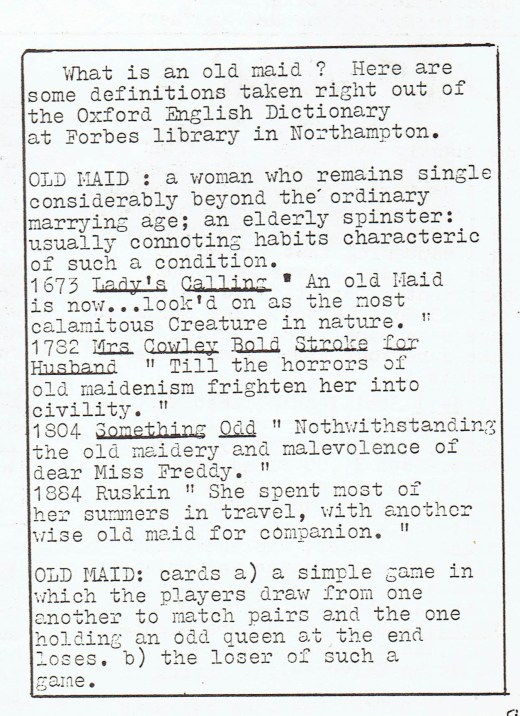
definitionold maid
From the Old Maid, Spring 1975

In the late Fall of 1975, the Lesbians coordinating the use of Lesbian Gardens proclaimed it to be 24-hour Lesbian space, contentiously precluding its use by straight VWU feminists. The Sweet Coming Bookstore (more like a bookshelf) was established there to sell the scant but growing number of Lesbian publications from around the country: the first mimeographed and stapled issues of Lesbian Connection, coming out stories, health information, news and discussions by and about Lesbians. A Lesbian distributor, Old Lady Blue Jeans, also began to have locally created products for sale there. An album by local musician Linda Shear, as well as some coloring pages by me as Great Hera’s Incunabula, were listed in Old Lady Blue Jeans’ catalog.

The BiMillennial Lesbian Week collaboration between Northampton, Springfield, Amherst, and hilltown Lesbians provided a supportive base for a Lesbian cultural flowering and new level of feminist activism over the next decade.  A significant portion of it was to happen in Northampton, which seemed to have a population explosion of newly-out lesbians. Though this Valley Lesbian Movement was to be fraught with struggle, both internal and external, its very depth and breadth was to exhibit a maturity that reflected the same pains, questions, doubts, and resolve experienced across Lesbian Nation.

*Valley Women’s Union initial coordinating board represented Mother Jones Press, Women’s Film Coop, Employment, Staffing, Newsletter, Childcare, Study and Research work groups.

SOURCES:

__[Raymond}, Kaymarion and Letalien, Jacqueline E., editors.  The Valley Women’s Movement: A Herstorical Chronology 1968-1978.  Northampton, Ceres Inc. 1978.

__Collective Lesbian International Terrors. “CLIT Papers, Part One and Two” and OOB Staff editorial. Off Our Backs. Washington DC. May and July 1974.

__Conference Evaluation Committee.  “1975 University Women’s Conference January 21-25: Report and Evaluation”. EWC, UMass Amherst Mar. 1975. I coordinated this conference and wrote parts of the evaluation including that about lesbians.

__Old Maid: A lesbian magazine. Northampton. Spring 1975.

__Old South St. Study Group. “Analysis of a Lesbian Community-Part One” and “-Part Two.” Lesbian Connection [E. Lansing MI]. Jul.1977.

__Kraft, Stephanie.  “BiMillenial Celebration: 2000 Years From Sappho.” Valley Advocate. 30 Apr. 1975.

__[Raymond],Kaymarion.  “The Cloning of Old Lady Blue Jeans.” Sharer’s Notes #3. Great Hera’s Incunabula. Nov. 1975.

_________. “Valley Women’s History”, Meeting notes. Common Womon Club, Northampton. 15 Apr. 1980.

“Green Street” Origins; 1970-78


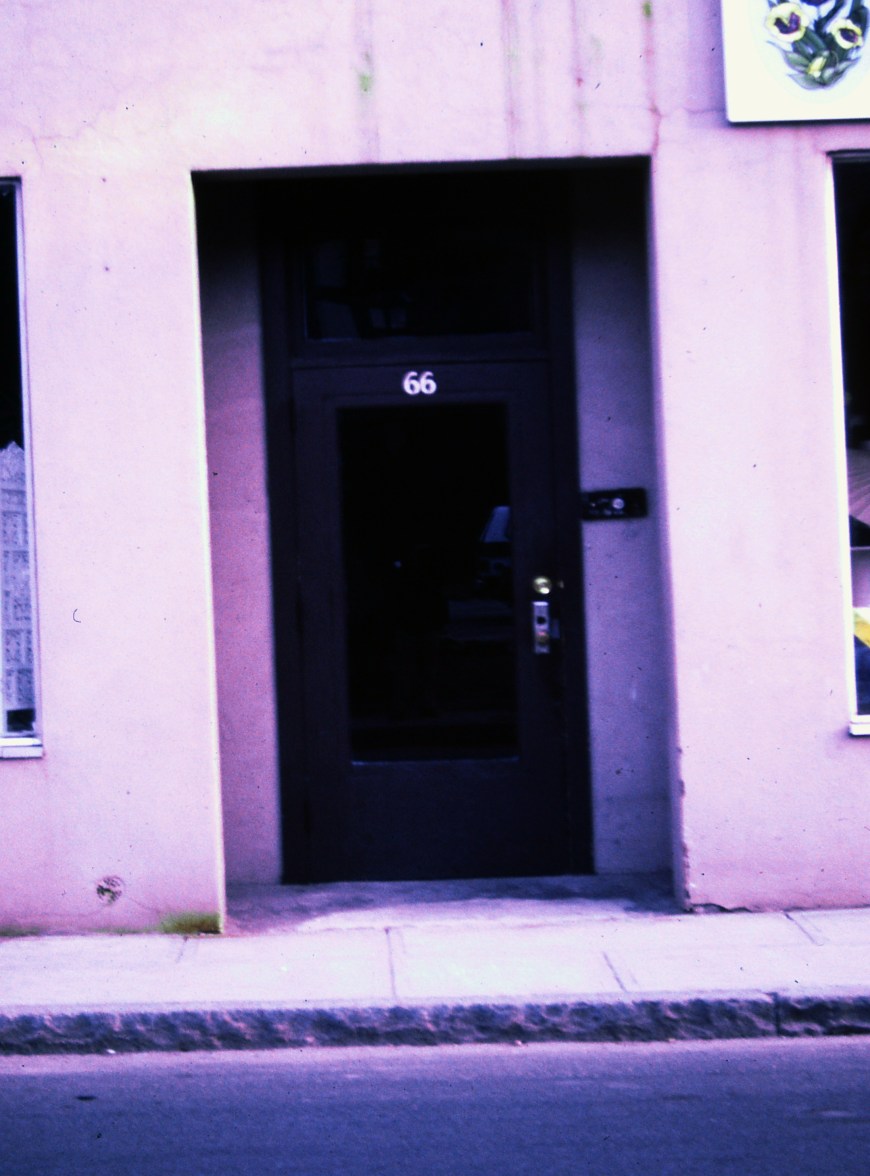
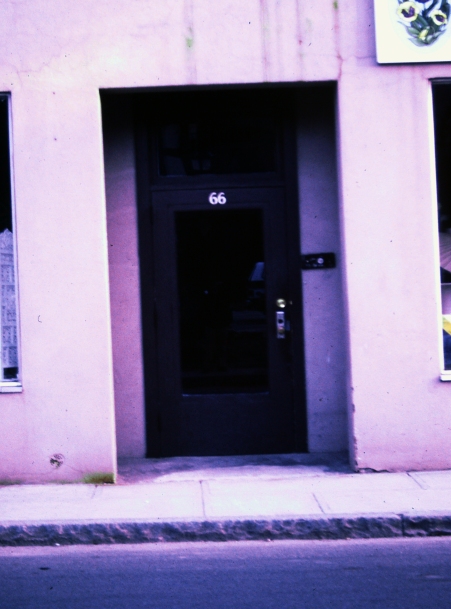
66 green
66 Green Street

In 1970, I had just started my sophomore year at UMass when I broke up with my partner Susan and needed a cheap place to live on the bus route to Amherst. Since I was in a non-functioning emotional state, it was only due to the one friend we had made in Northampton, Madeline Littlefield, that I got moved into a rooming house in town.

The old three-story house at 66 Green Street, with its maze of hallways leading out from a central staircase on the top two floors, looked as though it had been designed to be a rooming house. What had probably been a deep, covered front porch with a little yard and an adjacent alley, however, had been converted to cinderblock storefronts built right up to the sidewalk, though the two old apartments still existed behind them. One had to step back from the pink, painted, stucco front to get a glimpse of the original shingled edifice, which had steeply slanted roofs and a turret hiding a whole other world from that of the Smith College campus right across the street.

My beautiful picture
Three large old rooming houses next to each other on Green Street, number 66 on the far right with the blocky front addition.


“Elmhurst Apartments” was painted on the glass transom over the entry door located between the shops. The door led into a small, narrow foyer with flat, black, metal mailboxes affixed to the right hand wall and a carpeted staircase with wooden banister leading upward on the other. Dimly lit, creaking steps, slightly slanted into the void and crowded by a wall with painted over wallpaper, led to the fourteen rooms and two apartments above. There were shared bathrooms and hallway sinks on the second and third floors as well as a kitchen on the third which had originally been room #5.

Mrs. Snowden was the housekeeper, a term new to me. She was a combination manager and maid, sending the bed linens out to a laundry service but washing the towels in the basement machine. A furnished room for single occupant came with a weekly change of linen (one of the sheets, pillowcase and towel) for eight dollars a week. The top floor rooms had slanted ceilings, and those in the corners of the building claustrophobically fit only a single twin-size bed, dresser, and straight backed chair.

A few of the tenants were longtime residents, older single or widowed, retired or employed by nearby Smith College. They set a clean, quiet, mind-your-own tone. The majority, though, were transients, mostly men, who saw the ad in the Gazette, placed there whenever there was a vacancy. I recall people just discharged from the State Hospital up the hill and migrant workers between crops passing through.

Busy with school and multiple activities, I didn’t initially engage much with the other tenants, except for hellos and a worry that they might smell the pot smoke leaking into the hall through the blanket covered door and transom. Or notice increased noise and the occasional presence of a woman lover, as over the next couple years friends from Student Homophile League and then the Gay Women’s Caucus and Valley Women’s Center began increasingly to visit.

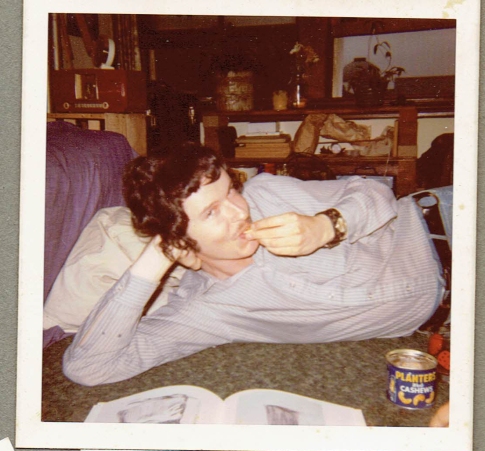
david j at g st
David J. SHL friend with stoned munchies. I had very little furniture.

Over time, I got to know a bit about the regulars.  The housekeeper Ada Snowden was friends with another widow on the third floor named Eva Crovo. The two of them could be heard clattering in the kitchen together every evening before and after they ate in Ada’s room.  On the second floor, the retired widower Abner Solon went out somewhere for the day, including, it appeared, all his meals. Living next to Abner at the top of the stairs to the second floor was Sophie Szarek, a retired old maid who was to become somewhat of a legend in those early years at Green Street.

After I had been living there a few months, I noticed that sometimes when I came home, just as I was reaching the top of the stairs to the second floor, I would hear a door slam shut. Sophie, that elusive tenant, would peek out of her room to see who was coming up the stairs and then hide before she was seen in return.  When I started taking a psychology class and learned of operant conditioning, I decided to try it on Sophie. Now when I came in, I called hello to her, and gradually was able to engage her in neighborly conversation.

Sophie had come from Poland to the Valley as a twelve year-old. A cousin had found her work as a maid in a “Yankee” household, which she did for her entire working life. Even with her heavily accented English, it was possible to understand her scornful contempt for all things “Yankee,” which seemed to extend to the few other women in the house, who never befriended her. I was able to introduce her to more congenial and increasingly bemused neighbors as friends of mine moved into the house.

sophie szarek
Sophie Szarek. Once she became a friend she would walk right into a room, even if you were sleeping  🙂

I was somewhat surprised when Mrs. Snowden asked me to substitute for her as the housekeeper over a summer. She worked as a cook at one of the Smith houses during the school year, but returned to her home in Nova Scotia when she could during the summer school break. The job at 66 Green Street broadly entailed renting the rooms and collecting the rent, cleaning the common areas and vacant rooms, checking the boiler, handling the laundry, and reporting to the landlord. In exchange, the room was rent-free and a phone paid for by the landlord was installed.  Mrs. Snowden was pleased enough with me that when she retired from her cook’s job in the summer of 1972 and wanted to return permanently to Canada, she recommended that I be her replacement.

For the next three years, as Green Street’s housekeeper, I filled every new vacancy that I could by word of mouth, with known or recommended women, most of them lesbian. In the remainder of 1972, eight women, five of them lesbian, filled vacancies. With the addition of another lesbian at the start of 1973, five of us collectively rented a room in the name of Kaethe Kollwitz that served as a common room. We also offered it as emergency housing through the Valley Women’s Center in Northampton and Everywoman’s Center at UMass. Over the two years we maintained the room, it temporarily housed a few famous and infamous women.

By Fall of 1975, I was ready to quit the job. Lesbians now lived in the majority of the rooms and one of the apartments at “Green Street,” as it was increasingly referred to in the women’s community. As the town built elder housing, all but one of the senior tenants had moved to those better accommodations. They took their moderating influence with them.  As well as a 100% turnover in tenants, usual for a rooming house, the change brought increased noise, traffic, and mess in the common areas, which increasingly frustrated me as housekeeper.  I had to draw a large poster for the bathroom illustrating how to replace a used-up roll of toilet paper.  I’ve been reminded by a former tenant of the time I went in the kitchen and threw every unwashed dish, glass, skillet, pot, utensil (piles of them) out the third floor window. I kept living at Green Street even after I was no longer the housekeeper.

Peggy C., old UMass friend and resident down the hall from Sophie and Abner, agreed to take over the job with the landlord’s blessing. However, the ever-increasing cleaning chores and wrangles as the “authority” figure discouraged her, too, and within only a couple weeks she was ready to quit.

Peggy C. housekeeper, after me, for a very short time,

Faced with the possibility of losing this now largely women’s, space, the tenants agreed to experimentally form a sub rosa cooperative that would share the work of maintaining the house and making decisions, including who would live there, greatly reducing the responsibilities of the landlord’s hired housekeeper, now the secret tenants’ co-op’s front person as well.

Kate A. became the first housekeeper under this new arrangement toward the end of 1975. A notebook was set up on a dresser in the second floor hall as a house communications log, with the weekly job rosters, house rules, and meeting notices. Over time, messages about happenings in the community as well as individuals’ lives accumulated in the log. [The log has been preserved at the Sophia Smith Collection, Smith College with appropriate use restrictions.]

By the time I left in 1978, to be with my dying mother, at least seventy different women, mostly lesbians, had lived at Green Street over that five year period, some multiple times. A few stayed for only a week or two, others rented for years, with 6-8 months being the average stay.  Though many were college educated, initially most lived there because it was the cheapest housing available and near the bus route. Being able to be open with each other and have like-minded neighbors became a desirable bonus.

The drawback was that it was often like living in a soap opera, witnessing fights between lovers or class clashes in the hallways. Because so many of us were to be involved in creating the new Lesbian community, community conflicts carried over into our living space as well. Green Street’s story as a Lesbian cultural institution continues well into the next decade and beyond. That, as well as little tales from the seventies as they are relevant, will be included in future blog posts.

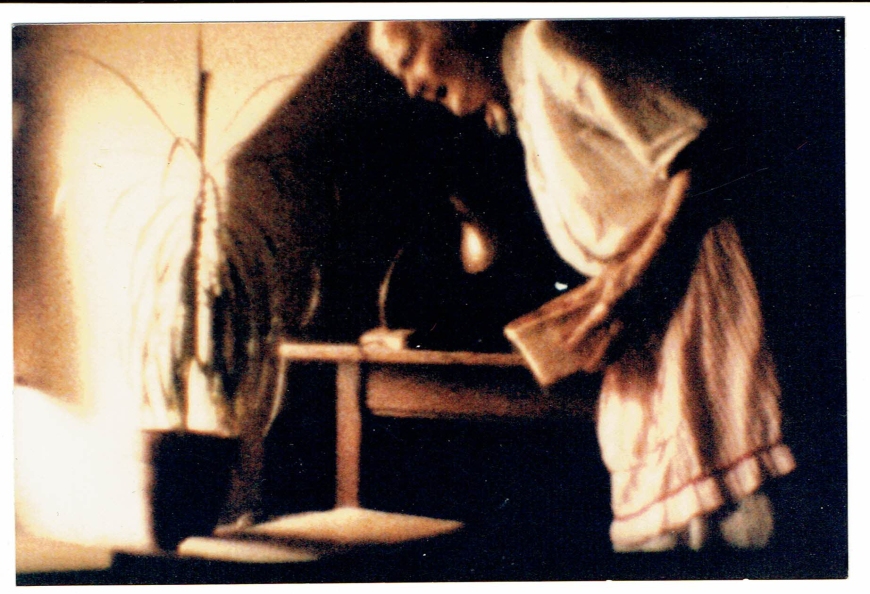
My beautiful picture
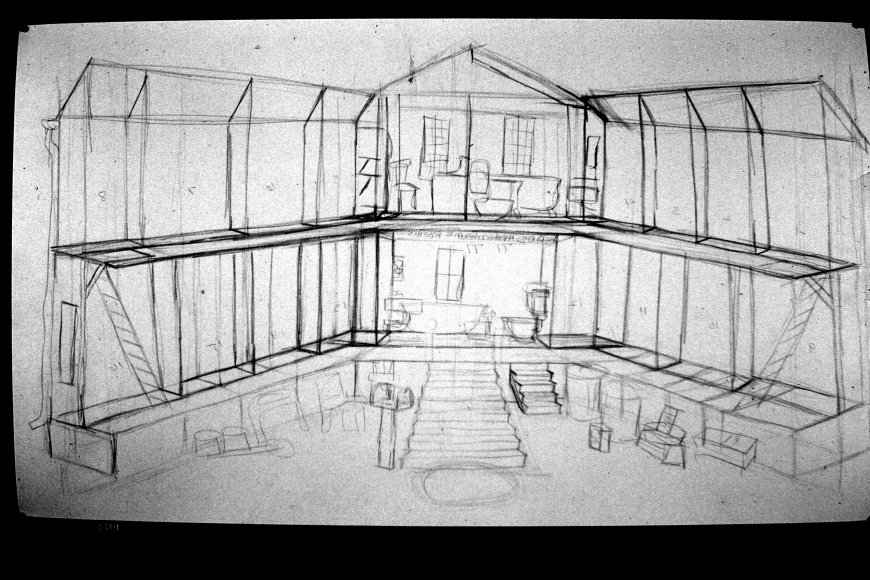
Stage set design for “Green Street; the Soap Opera” by Kaymarion Raymond