A Revolution of Sorts


The friction of contradictions fire the crucible out of which Northampton community formed.” This sentence is how historian Kerry Buckley introduced Historic Northampton’s 2004 update of the city’s story, A Place Called Paradise ”The dynamic between factions_ newcomers and old-timers, Yankees and immigrants, young and old, has always been part of the creative tension that, at its best, has enlarged the community’s capacity for tolerance.”

Add LGBTQ peoples to Buckley’s list of contrary factions. LGBTQ peoples in large numbers came to, or came out within, Northampton starting in 1970, creating friction both in the town and amongst themselves. Peoples, in the plural, because it has been successive waves of differently-identified persons who have emerged, come out, gathered, organized, agitated, advocated, and created on their own behalf. There have been multiple peoples over more than four decades, with little in common except an outlaw status — outside heteropatriarchal marriage (until 2004) and stigmatized — that has formed the basis for occasional coalition and a more mythical community.

LGBTQ people were here in Northampton all along, just not visible until starting in the 1970s various populations, sequentially, came out to each other swelling to a critical mass  that allowed for  organization. Lesbians; then gay men; then their parents; add queers and bisexuals, here come transsexuals, and transvestites; don’t forget young people; how about spouses or significant others? Each newly emerging group defined themselves, voiced their needs to each other, and added unique solutions to respond to those unmet needs. Each group spun themselves into the fabric of a subculture that gradually became more visible on Main Street. Chief among the needs for each group of people have been safe and supportive ways to meet each other, and, as increasing numbers of people came out and met, new groups or activities formed to meet increasingly specific needs.

Collectively (and fractiously) growing in strength over time, the activity centered in Northampton often provided an organizational nexus for all of Western Massachusetts. The long-lived and most visible LGBTQ cultural institution, the annual March/Parade (under varying names), began as a coalition for change in Northampton, reflected the shifts in politicized populations over time, and became a forum of expression for all of the region. As part of a state and national movement of change, a loose alliance of groups centered here helped bring new civil liberties in the state as well as inclusion in the politics of the municipality.

Some would say an integration of sorts has been achieved by these LGBTQ peoples, with many needs now met by mainstream institutions, and visibility largely unremarked upon in most parts of town. There is a record of groups forming and then falling away over time, but was that because they were no longer needed? The reasons for this could be explored in this blog, as well as a search for any lessons about creating change that can be applied to this new era. And still to be painted is a portrait of Northampton LGBTQ (add the latest initial) today, to hold up in comparison to that of the 1960s isolation. What has stayed the same? What has changed? What still is needed? Who is going to create something to fill that need? And can history hand them some tools to do it with?

COMING NEXT: An Overview of the 1970s.
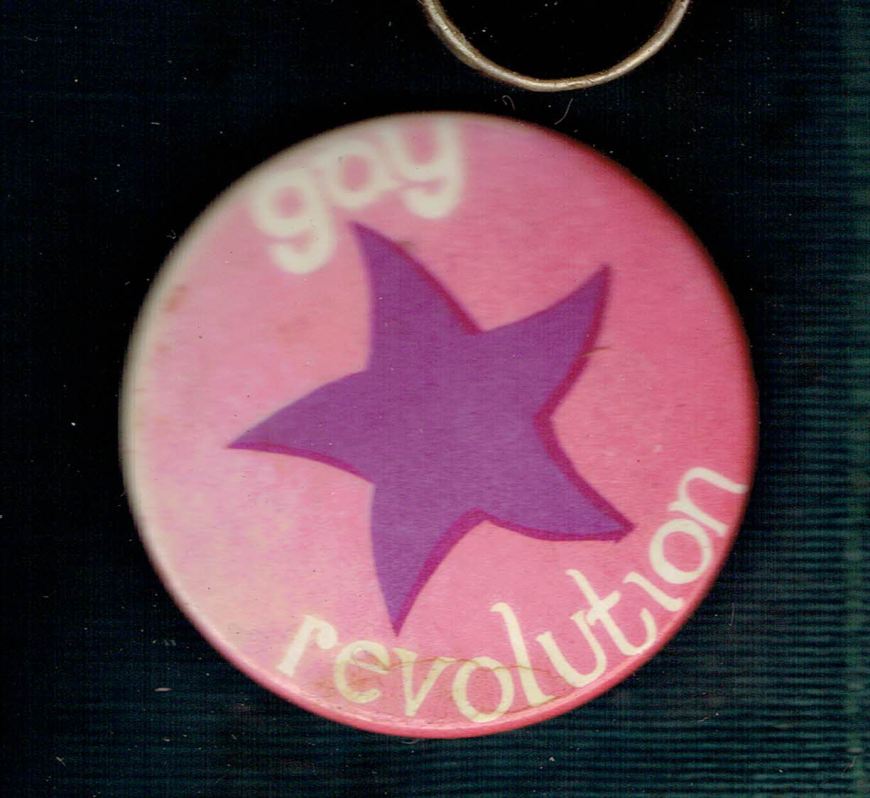
button gay revolution 197103202015
button I brought back from Christopher Street March NYC June 1971


Just Before the Revolution


Was there a gay revolution in Northampton? A look at the gay subculture that existed here just before 1970 may help answer that. I am still looking for and surveying existing literature but here’s a summary of one piece of research.

Lack of documents is one thing noted by Vincent Bonfitto in his 1990 search for Valley gay history prior to the modern gay and lesbian political movements. Only by interviewing seven older gays and lesbians (all of whom may have been white), including Warren Clark and Jean Grossholtz, for his Master’s thesis at UMass was he able to add a little to our sparse knowledge of post-WWII Valley gay subculture.

In general he found this subculture was largely limited to very private social networks meeting in each others homes; and, often isolated individual couple relationships. Gays and lesbians in this era often had to go out of town to find venues for meeting each other. The experiences of men and women and their subcultures differed in significant ways.

Those interviewed by Bonfitto noted that social life for gay male academics centered around private Smith College cocktail parties and trips to Jacob’s Pillow dance center in  Becket MA in summer. Gay male social life was absent at Amherst College, where a gay male faculty member had been asked to resign in the 1950s. No information was included on UMass, except that couples existed. One social network consisted of gay priests in the diocese. Three of the four men interviewed had lost jobs because of homosexuality, one not rehired at Amherst High School in 1962 for, among other things, being “effeminate.”

Gay men in the Valley cruised public facilities for anonymous sex in Amherst, Holyoke, and Greenfield, as well as Northampton. The largest cruising grounds familiar to the men were in Springfield, including the lobby of the Bridgeway Hotel, a huge public men’s room next to City Hall, and the park behind Old First Church off Court Square.

The nearest gay bars were also in Springfield. Though they occasionally were visited by gay women, they were largely for men, with varying clientele. The fourth floor bar and restaurant Blakes was run like a private club, very “high class,” and had drag balls during the holidays. The Arbour was a formal, “posh” piano bar for the over-thirty crowd, while the Arch and Sports Lounge were more informal and mixed class. The Arch, in particular, was known as a pickup place. Bonfitto doesn’t mention the race of bar patrons, the location of the bars, or dates of existence.

Gay women’s or lesbians’ culture appears to have been much more restricted and largely separate from the men’s. Throughout his thesis, Bonfitto refers to the women as “lesbians,” with no note of the actual self-referents of those he interviewed. The three women noted very closed social networks, little bar attendance, but the known existence of a reputed butch-femme bar culture with alcohol-fueled violence. At Mt. Holyoke College, students who came out (were discovered) were moved by the administration to live by themselves in single dorm rooms or off campus. The only alternative to the Springfield bars mentioned above, for women,  was attendance in Boston at Daughters of Bilitis events and vacationing in Provincetown.

Aside from Bonfitto’s thesis there are a few other published sources I have yet to review that contain bits about this period. Some scraps have come my way. I was told by a Smith College alumnae who came to live at Green Street in the early 70s that she had been suspended for a semester and sent home to get psychiatric treatment because her feelings for another woman became apparent to others.

In 1969, among the many old WAC friends who visited my partner Susan and me in Williamsburg, was a gay female couple then living in New York. They brought the portentous news that one of them was transitioning to male. Because of Susan’s regular correspondence with Ladder editor Barbara Grier, our friend Karl (literary pseudonym) wrote what may have been the first article on transsexuals published by the magazine. In 1972, the couple, now legally married and with an adopted child, moved to Northampton and totally assimilated.

The Ladder Apr/May 1970. Written by a transsesexual who moved to Northampton in 1972 with his wife and child.
The Ladder Apr/May 1970. Karl (a literary pseudonym) moved to Northampton in 1972 with his wife and child.

The semi-rural nature of the Valley and the generally small size of towns, even those with academic institutions, undoubtedly contributed to the very private and often isolated existence of gay people in Northampton and the area prior to 1970.

What began to change and how it happened are the topics of the next series of blogs on the 1970s. I am very much looking forward to getting my personal copy of Lillian Faderman’s new history the Gay Revolution. It’s been given fine reviews and I’m sure, like the other volumes I have of her work, I will underline, highlight and scribble madly in its margins. A timely publication that can be referred to as we lay out the story of the revolution here in the Valley. Stay tuned in!

COMING NEXT: A Kind of Revolution: Overview.

SOURCES:
__Bonfitto,Vincent F. “The Formation of Gay and Lesbian Identity and Community in the Connecticut River Valley of Western Massachusetts, 1900-1970.” Journal of Homosexuality, Vol. 33(1) 1997, 69-96. Haworth Press. I will include more material in future blogs.
__Ericsen, Karl. “The Transsexual Experience.” The Ladder, Apr/May 1970, 25-27. Daughters of Bilitis, San Francisco.

FUTURE WORK? LOOKING FOR: I have also been told about, but not yet verified and researched, semi-pro women’s baseball and basketball teams in Springfield, and a Valley-wide industrial women’s softball league that may have existed in the 1960s. Who knows about this? Also were there male equivalents? Or bar leagues as have been found in other large cities? Does anyone know the location of the Springfield bars mentioned by Bonfitto, or (pie in the sky) have photos? I will post a blog soon on the Girls Club, lesbian bar in Chicopee started in the 1940s.

Scraps of the Past


In 2004 Mark Carmien, owner of Pride and Joy (the LGBT gift and book store on Crafts Avenue in Northampton at that time), got a phone call from a man saying that his gay uncle had died and in cleaning out the deceased’s home he had found some memorabilia. What, the caller wondered, should he do with it?

Carmien got in touch with Northampton’s unofficial gay archivist, Phil “Bambi” Gauthier, who collected the box of material dropped off at the bookstore. The box contained gay erotic magazines and several albums of undated color Polaroid photos.

These photo records, though undated, would probably have been from 1965 or later. Polaroid color cameras first became available in 1963, and they released their most popular low priced “Swinger” model in 1965. One obvious benefit of these cameras was cutting out the need to have the photos developed by someone else, and risk censorship or worse for any erotic content.

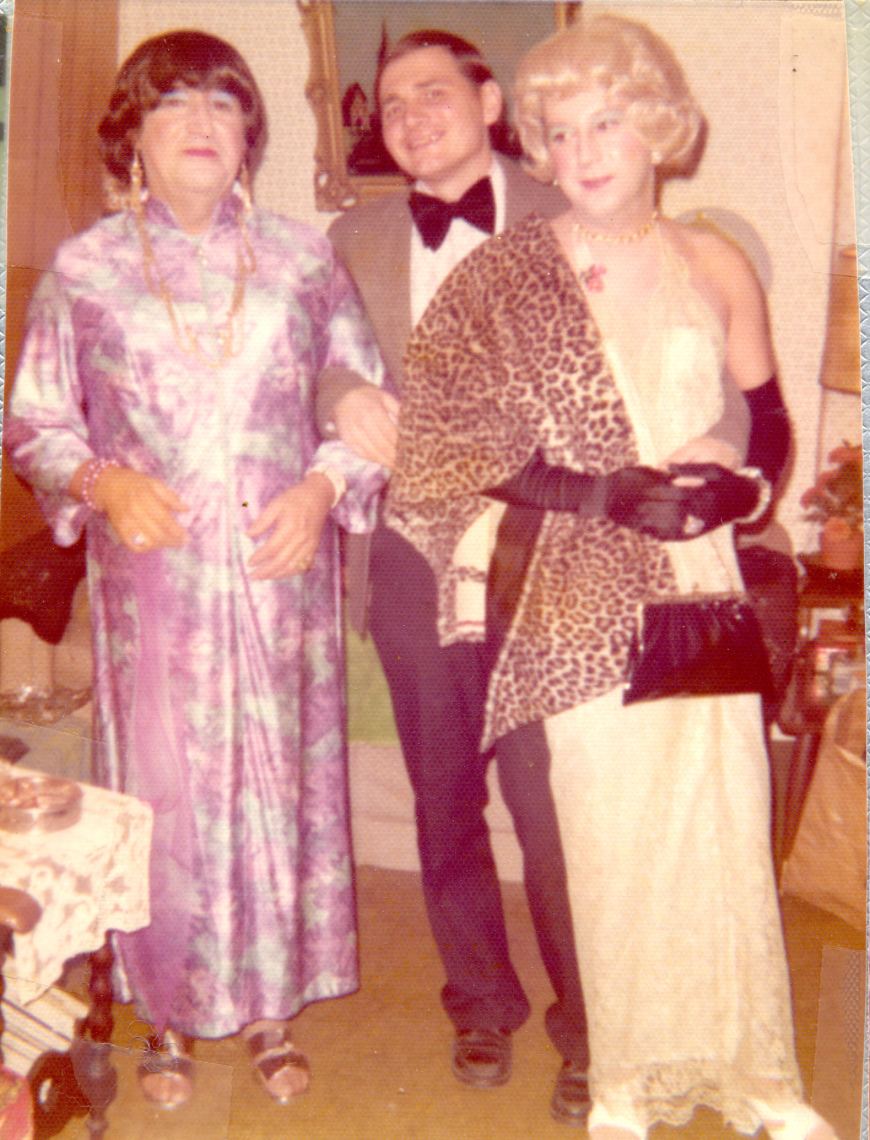
Two of the albums passed to Bambi were filled with no-face-showing close-ups, obviously in a private home, of erections and asses. As he leafed through the third album, browsing the selection of candid but more clothed snapshots from many home parties held or attended by the Springfield man during the 1960s and 70s, Bambi came across several snapshots of his own “grandmere,” R. Warren Clark, dressed as Sophie Tucker.

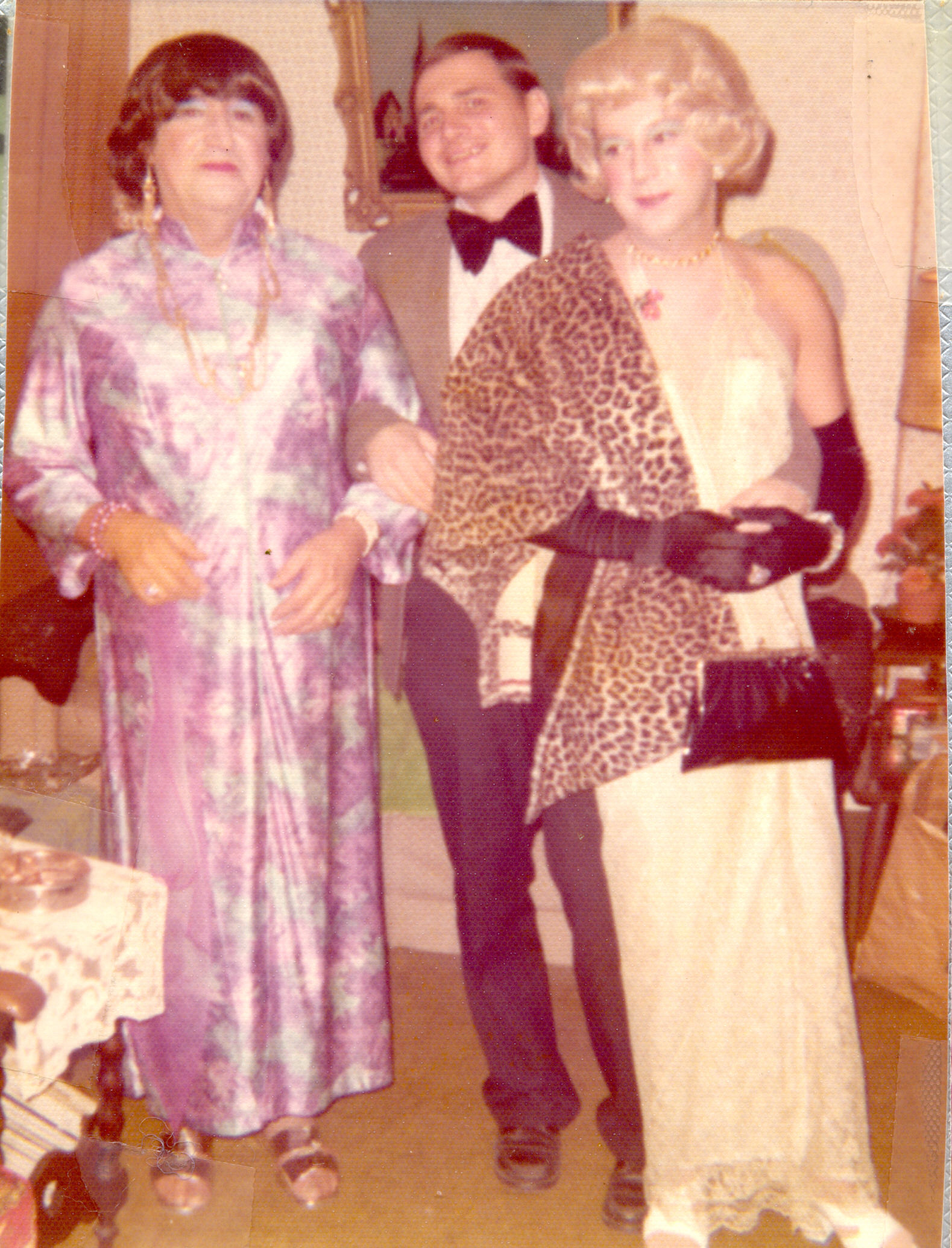
“Sophie Tucker” Warren Clark (on right) of Northampton at a drag party with unidentified escort, probably in Springfield during the late 1960s or 1970s. Source: Phil Gauthier collection

In 1987, the then-nineteen-year-old Gauthier had decided to join the local chapter of Integrity, and asked two Northampton gay “elder statesmen” to stand as his baptismal godparents. The two men, Warren and Ralph Intorcio, had for decades been part of a small circle of gay male friends who met regularly for little suppers. Many worked at the VA Hospital in Leeds, and were married with children, sharing their gay life only very privately with each other.

Interviewed in 2004, Bambi remembered Ralph coming home several years after his baptism with a few boxes belonging to one of those men. The friend had just died and, as per the contract this small group had with each other, Ralph used the key he had been given to go into the deceased man’s home and remove anything indicating his secret life before relatives might discover it. Bambi remembered getting brief glimpses of that secret life as he handed letters of WWII and Korean War soldiers—along with photos of them arm-in-arm, many with cheeky and loving notes on the back–to his godfather who fed them into a fire in the woodstove on the summer porch. Seeing this history disappear was one of the saddest things Bambi had ever witnessed.

Fifteen years later, because of a thoughtful nephew, Gauthier had a piece of the past that usually got destroyed. Most of us don’t think about the fact that as we live, we are making history. We don’t think about the history books that can be written only based on whatever documents have been saved or memories have been recorded. In recent decades many people have moved away, taking with them group records, flyers, news clippings and correspondence. Others have thrown out journals, letters or scrapbooks. Many boxes of documents are moldering in basements, attics, or garages.

SOURCES:
__Gauthier, Phil “Bambi.” Conversations with, Sep.2004, Northampton, Mass.
__http://polaroid.com/history  .

__Sophie Tucker, last of the “Red Hot Mamas”; very lovely tribute video on Youtube https://search.yahoo.com/yhs/search?p=sophie+tucker+video+biography&ei=UTF-8&hspart=mozilla&hsimp=yhs-001

__Integrity is a group within the Episcopal Church for LGBT people, formed nationally in 1975. The local chapter is St. John’s on Elm Street, founding date and other history still unknown. Do you know?

COMING NEXT: What else is currently known about Northampton’s gay world just before the revolution, the beginning of lesbian and gay political activism in 1970? Watch for Scraps of the Past part two surveying research literature as well as more personal anecdotes.

Changes and Closing: Hampshire Bookshop, part four


Historian Barbara A. Brannon notes a change in the working relationship between Hampshire Bookshop founders Marion Dodd and Mary Byers Smith that coincided with the arrival at Smith College in 1922 of Esther Cloudman Dunn, a professor of English. In 1925, Dunn became Dodd’s housemate. They were partners for the rest of their lives. The two rented joined apartments at 76 Crescent Street which allowed them each to have office space. The offices had custom bookshelves made by Marion. Since 1921, Dodd had been hosting summer reunion picnics at her restored farmhouse in Maine for invited Smith alumnae. Now Dunn and what Dodd called their “literary” cat joined her for summers there.

In 1927, Mary Byers Smith resigned from the presidency of the bookshop. Though she remained on the board, she withdrew from direct involvement with the business. Smith never married, but had family obligations, including an aging mother, in Andover. After she moved back there, she remained in touch with college friends, chief among them Grace Hazard Conkling, English professor, poet, and divorcee. She also continued to be active in Smith College affairs, particularly in the Friends of the Smith College Library.

Frequently in town for business, Smith often stayed with Margaret Storrs Grierson, a professor of English and college archivist at Smith. Grierson eventually met a life companion, Professor of French Marine Leland. They met among Esther Dunn’s close circle of women friends, and lived in a house near Dunn and Dodd’s final home on Massasoit St.

At home in Andover, Mary Byers Smith had a historic building renovated as her own home near the one she was raised in, employing a woman architect. She did volunteer social work at Tewksbury State Hospital, served the Andover community on the school and library boards in the local library. In later life, she returned to college at Radcliffe and bought a home in Boston, where she expanded her volunteer work and friendships with women in professions, particularly social work. After Smith’s death in 1983, her personal letters were destroyed at her request.

In 1931, the HBS opened a branch on Green St. to accommodate students more readily as the campus grew westward down Elm Street. Other notable expansions included the production of bookfairs, and a traveling bookshop (station wagon) that traveled to prep school campuses and other venues to sell books.

As she neared retirement age, Marion Dodd began training a successor. Cynthia S. Walsh (Smith ’39) joined the HBS board of directors in 1943, then was hired as assistant manager in 1947. Like Dodd, she was unmarried and shared her home with another woman, Frances Mayhew, in a discrete lesbian relationship. Dodd retired in 1951. She hired Walsh as manager, but stayed on as chair of the board until 1957.

Marion Dodd died in 1961, leaving her estate to Dunn, who in turn, after her death in 1977, donated a portrait of Marion to be hung in Wright Hall in a room bearing Dodd and Dunn’s names. Dodd did not live to see the demise of her beloved enterprise. After fourteen years as manager, in 1965, Walsh was forced by personal circumstances to resign. Within a year, the Hampshire Bookshop was sold. In 1966, Robert T. Hale bought it, only to resell it in 1969 to Ralph and Oudi Intorcio, who had no bookselling experience. The business had declined so substantially that it soon was auctioned for debt. Of note is the fact that Ralph later found fame in Northampton with the Young at Heart Chorus.

While I had visited HBS shortly before it closed its doors I had forgotten about this remarkable enterprise until reminded by Northampton resident and historian Jan Whitaker. And it seems particularly poignant that in 1979 when the Valley’s first feminist bookstore Womonfyre opened on Masonic Street none of us knew that the grandmother of all women’s bookstores had existed, gloriously, a few short blocks away. I like to think that the ghosts of the remarkable HBS proprietors still linger, even unrecognized, to bless ventures by women in Northampton that inform, inspire and connect us.

Source:
__Brannon, Barbara A. “No Frigate Like a Book”: The Hampshire Bookshop, 1916-1971. Unpublished Doctoral dissertation. University of South Carolina, 1998. Dr. Brannon has a new webpage  http://www.barbarabrannon.com/

Coming Next: Scraps of the Past: Just before the Revolution

Hampshire Bookshop 1916-1971: Beginnings


Marion Dodd, a man’s shirt and tie showing under her overcoat, holds a large basket of gifts that Grace Coolidge, the former President’s wife, hands out to departing draftees at the Northampton train station sometime during World War II. This Hampshire Gazette photo highlights the public prominence of the woman long at the heart of the Hampshire Bookshop (HBS). “Her masculine style of dress and demeanor – tailored suit, four-in-hand tie, closely cropped hair, cigarette smoking, direct speech – are still remembered by those who knew her,” writes Barbara A. Brannon in her dissertation on the Hampshire Bookshop. “Dodd is also most frequently noted for her avid hobbies of woodworking, sailing, and motoring, and her longtime ‘Boston marriage’ with Smith Professor Esther Cloudman Dunn.”

While Brannon’s dissertation, “No Frigate Like a Book,” largely focuses on the Hampshire Bookshop’s pioneering endeavors and influence in the profession of bookselling on a national level, she has uncovered enough detail on the HBS to delineate a “homosocial network” (my emphasis) of former Smith classmates, other alumnae, faculty, and staff that the bookshop drew upon, strengthened and expanded as it became an important center not only of several generations at Smith, but also of literary activity in the region over its fifty-five year history. Brannon’s scholarly work is the source of much of the information that follows.

At least half of the bookshop’s staff and most of the board of directors had some association with Smith. Most were women. With this essential support, the Hampshire Bookshop boldly pushed the limits of what a bookstore could be. Beyond being one of the first woman-owned and managed bookstores in the country, HBS was successful at much more than selling books. The HBS also maintained a student cooperative that returned profit to members, published more than forty books and lecture pamphlets under its own imprint, and brought more than a hundred authors of national and international repute to Northampton to present readings and lectures.

Marion E. Dodd (Smith ’06) and Mary Byers Smith (Smith ’08) incorporated the bookshop in 1916 with initial support from two other Smith alumnae, Emma P. Hirth (Smith ’05) and Edith E. Rand (Smith ’99), who lived together in New York City. The four of them became the first Board of Directors and with 82 other stock holders gathered an initial $25,000 in capital. They leased space at 41 Elm St. in a house purchased by Rand as the agent for the Smith Alumnae Association (now Duckett House). The Hampshire Book Shop, as it was initially named, opened for business in three first floor rooms staffed by Dodd and Louise Bird (Smith ’16).

In its first two months, the student cooperative enrolled more than 1250 members, and within a year HBS had outgrown the space. In 1917, they rented space at 192 Main Street in Shop Row. The business expanded so rapidly that within five years they ventured to raise another $25,000 in capital through the sale of stock and purchased their own building, moving to 8 Crafts Avenue in 1923.

The HBS choose as its motto a poem by Emily Dickinson that begins, “There is no frigate like a book.” The bookshop especially promoted poetry. Poet Robert Frost was an appreciative guest speaker at its Crafts Avenue housewarming, as well at later celebrations,. The new store, which was to house the main business for the rest of its life, featured woodworking by Dodd as well as a second floor lecture and exhibit space that seated 125.


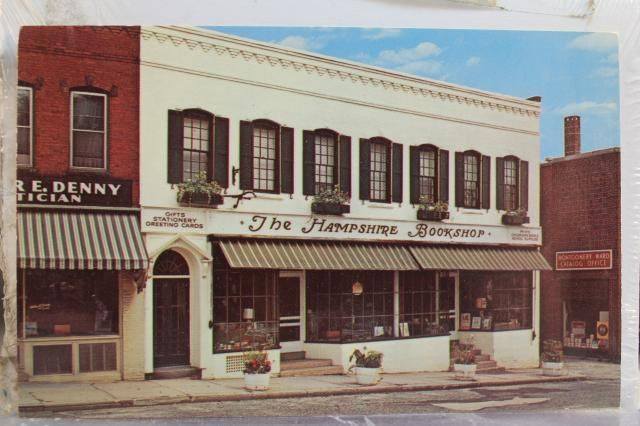
hampshire bookshop
Hampshire Bookshop, 8 Crafts Avenue , the Metcalf building (Historic Northampton)

Sources:
__Brannon, Barbara A. “No Frigate Like a Book”: The Hampshire Bookshop, 1916-1971. Doctoral dissertation. University of South Carolina, 1998. Unless noted most of the information in this series of articles on HBS is drawn from this dissertation. Copies of it are available at Smith College and UMass/Amherst libraries. http://www.barbarabrannon.com/
_____________________ “The Pioneering Journey of the Hampshire Bookshop: the First Ten Years.” In Paradise Printed and Bound: Book Arts In Northampton & Beyond. City of Northampton. 2004. A more accessible (try local library or WMRLS) and briefer summary that includes new financial detail as well as photos.
__”Hampshire Bookshop Incorporated at Boston.” Daily Hampshire Gazette, 29 Apr 1916.
__Smith, Mary Byers. “New Book Store In Elm Street House.” Daily Hampshire Gazette, 12 Apr 1916.
__”The Hampshire Book Shop.” Daily Hampshire Gazette, 2 Oct 1916.
__”An Hour In The Hampshire Book Shop.” Daily Hampshire Gazette, 6 Dec 1916.

Looking For: Photos of Dodd, Smith and others.
Coming Next: Hampshire Bookshop Founders Marion E. Dodd and Mary Byers Smith.