Last Saturday, May 2, 2020, would have been the 39th Noho Pride parade and rally. Because of the COVID-19 pandemic it was cancelled and a video compilation provided a virtual substitution. It is a good time to remember the event’s birth pains.
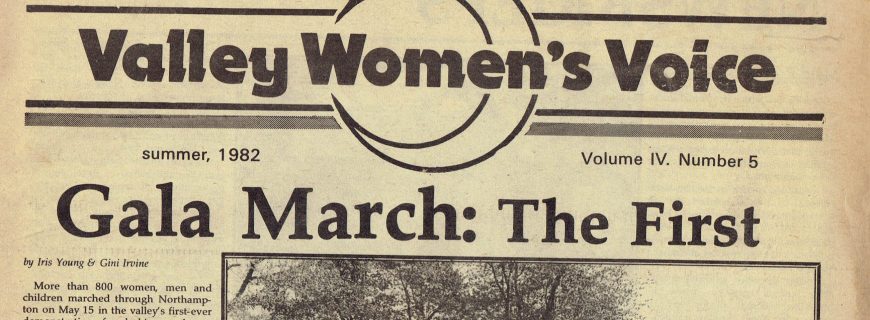
The First March: May 15 1982
For years, people from Western Massachusetts drove to Boston to attend a Lesbian/Gay March, which started there 1970. There was an unsuccessful attempt in 1978(?) to start a similar event in Springfield. Finally on May 15, 1982, Northampton became home to Western Massachusetts’ first Lesbian/Gay March.
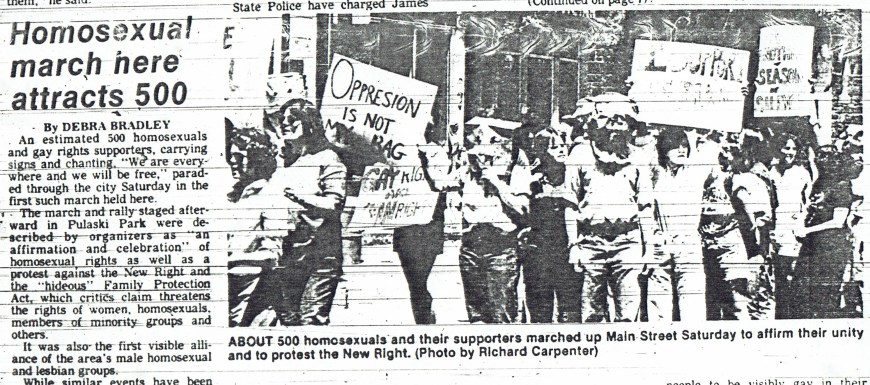
Daily Hampshire Gazette front page May 17, 1982
The first Northampton march had no official name, but was billed as being held in support of the Lesbian and Gay Community and to protest the Family Protection Act. The Family Protection Act was proposed federal legislation that would ban a wide variety of services to gays as well as people of color, immigrants and the poor. The Gay and Lesbian Activists (GALA) organizers, applying for a parade permit, estimated 70-150 people would participate. Instead, an enthusiastic 600-800+ Lesbians, gay men and allies turned out. [I have reblogged the post about that first march and you can also find it through this link. https://fromwickedtowedded.com/2017/01/19/election-reflection/ ]
That first public outing of Lesbians and gay men in Northampton happened in an already hostile local atmosphere that had been energized by the national emergence of the New Right and election of Ronald Reagan. Lesbians had already begun to be targets for violence in the late 70s, when they first become increasingly visible. In early 1980, Lesbians and Gay Men Against Violence, an ad hoc group, picketed two area cinemas for showing the anti-gay film “Cruising,” which featured a serial killer of gay men. One of the organizers, David Jolly, told press that seeing gay people as fair game for such media stereotyping could lead to a backlash of violence against the gay community.
Several months later, four men invaded Womonfyre Books, a women’s bookstore on Masonic Street, threatening to vandalize the store and rape the Lesbian proprietors. Later, adding to community alarm, was the reappearance of the FBI . The Northampton Law Collective (formerly the Women’s Law Collective) warned in May 1982, the month of the first march, that several people in recent months had been stopped and questioned by agents. Again, people in the community were advised by the Collective they had a right not to talk to the FBI.
There was resistance from some of the City government to the idea of that first march. The City initially refused to waive the permit fee, as was traditional for other groups wanting to parade. Only five days before the event, City Councilman Mario Mazza denied the organizers access to Memorial Hall electricity to power the rally speaker system. Accounts differ as to whether Mayor Musante overruled Mazza or if the Unitarians eventually provided electricity. What is certain is that in an early act of solidarity, the Unitarians offered an electrical connection from their building near the Pulaski Park rally site.
The night before the 1982 march, the GALA organizers were phoned with threats of violence at the event. Nonetheless, the day went well, with reports of only a bottle and, then, a raw egg being thrown at marchers. The spectators lining the streets for the march were mostly surprised at the large turnout. Some were curious or thought it was fun. Some sneered or expressed disgust. The Daily Hampshire Gazette substituted the word “homosexual” for “gay” in their coverage wherever they could while printing an editorial congratulating Northampton on its tolerance of such an historic event.
Councilor Mazza’s attempt to sabotage the first GALA March was not forgotten in the following months. Efforts began to engage local Lesbian and gay political power. In August of 1982, a voter registration drive to involve more Lesbians in town politics began. The Pioneer Valley Peoples’ Gay Alliance’s political action committee began polling those running for state office. The need for more direct activism, however, soon became evident.
Assaults On Lesbians: Autumn 1982
Accounts of the initial outbreak of violence are varied, likely because of Lesbian reluctance to be out and the private horror of the crimes. As best as can be reconstructed, during a seven week period in the autumn of 1982, at least four women (three Lesbians) were assaulted on Market, Old, and New South Streets. Three of them were raped. One was beaten so severely she lost consciousness. According to the survivors, three men in a van, who approached “dykey-looking” women asking directions, made two of the attacks. Anti-lesbian comments were made during two of the assaults. One of the women, while still recovering in the hospital, received a taunting phone call from an anonymous male. The language used by him was similar to that used in the phone harassment that became widespread in December.
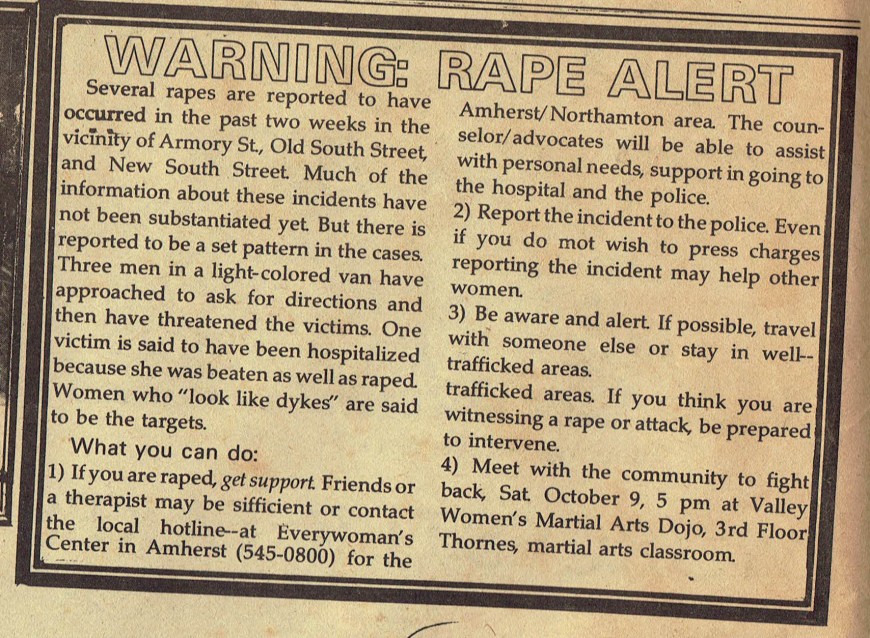 Valley Women’s Voice Oct. 1982
Northampton’s Lesbian community was close-knit. Word of the assaults, including their frequency and pattern, spread quickly by word of mouth. In October, the monthly free newspaper Valley Women’s Voice printed a rape alert and notice of a Lesbian community meeting. About 200 attended this gathering at The Valley Women’s Martial Arts’ new dojo in Thorne’s Market. A week later, in another community meeting convened by Jean Grossholtz, Lesbians considered the violence in context of the fundamentalist resurgence against all minority groups. The facts that the KKK was making new appearances in Springfield and that the Gay Community News office in Boston had recently been torched pointed to the need for wide coalition building.
An ad hoc group calling themselves Northampton’s Town Mothers drew attention to the assaults by posting a curfew ordering all males over the age of twelve to be off the streets after 6pm on Oct. 31. Halloween was a night when violence against women and children increased. Three hundred posters, with a faux City Seal, were placed at all the routes leading into as well as around town. In November, GALA organized a march against the Klan attended by about 200 people, many of them lesbians, in addition to members of the UMass Third World Women’s Task Force and the New Jewish Agenda.
Telephone threats begin: Dec. 1982
The new round of assaults began in early December by phone. The New Alexandria Lesbian Library in Leeds had messages left on NALL’s answering machine by an unidentified male. One threatened to “get” the manager and all other “dykes” in the area. “I think you lesbians are scum. You’re the sickest things on earth. You’re the most disgusting things that ever came to Northampton. We will never accept homosexuality or lesbianism in our town anymore.” Later the same night, a threat to break into her apartment was left on NALL’s phone machine. The manager reported the calls to the police, began keeping a log of these and other incidents reported by Lesbians, and brought them to another Lesbian community meeting which began to convene weekly.
In late December and early January, the Daily Hampshire Gazette printed what some saw as anti-lesbian/gay writing, two pieces by nationally syndicated columnist Joseph Sobran. Concurrently, at least three different males made an increasing number of threatening, obscene or annoying silent breathing or hang-up calls to not only NALL but to the Valley Women’s Voice monthly newspaper, GALA and Womonfyre bookstore. These were also reported to the City Police. Even when given copies of the taped messages, police response was that they couldn’t do anything, though they suggested a trap by the phone company might lead to evidence. Suspicious, women declined to have what they thought would be having their phones tapped. In spite of having been given, months previously, the license plate number of a van resembling that of the rapists, nothing was apparently being done about the rapes. In fact no one was ever arrested for them.
SHUN Puts Threats In Writing: Jan. 1983
Threats took a new form in mid–January of 1983, a day after Sobran’s second column appeared in the DHG. Three handwritten notes were left in the door at Womonfyre Books with further threats. Noting that they “agreed with the paper” that “gays must be persecuted,…eradicated,…never accepted,” they identified themselves as SHUN, “Stop Homosexual Unity Now.” Copies of the letters were given to police. Refusing to remain silent through lack of police action and escalating threats, Lesbians and GALA started their own letter writing campaign to state and city officials and the news media exposing the harassment. Letters were also sent to the Editor of the Gazette protesting the Sobran columns. These prompted additional anti-gay letters to the newspaper. When members of the Smith College Lesbian Alliance wrote pro-lesbian letters to the Editor, they also began to receive threatening phone calls. Some of the anti-gay letter writers later proved to have used false names in spite of the paper’s stated verification policy.
Toward the end of January, SHUN left another note at Womonfyre. It promised to “route (sic) out and expel this extremist homosexual germ by peaceful or violent means,” including burning to the ground Womonfyre bookstore and the New Alexandria Lesbian Library. The Valley Women’s Voice stopped listing their staff last names and publishing phone numbers in announcements without explicit permission. Joe Lamott, Pioneer Valley Peoples Gay Alliance coordinator, noted in the PVPGA Gayzette that the threats were obviously anti-woman and anti-lesbian, since none of the gay men who included their numbers in the group’s openly distributed newsletter were being targeted. Lou Thomas of GALA reported, however, that the lives of three openly gay men had been threatened to the degree that one of the men had had to move several times.
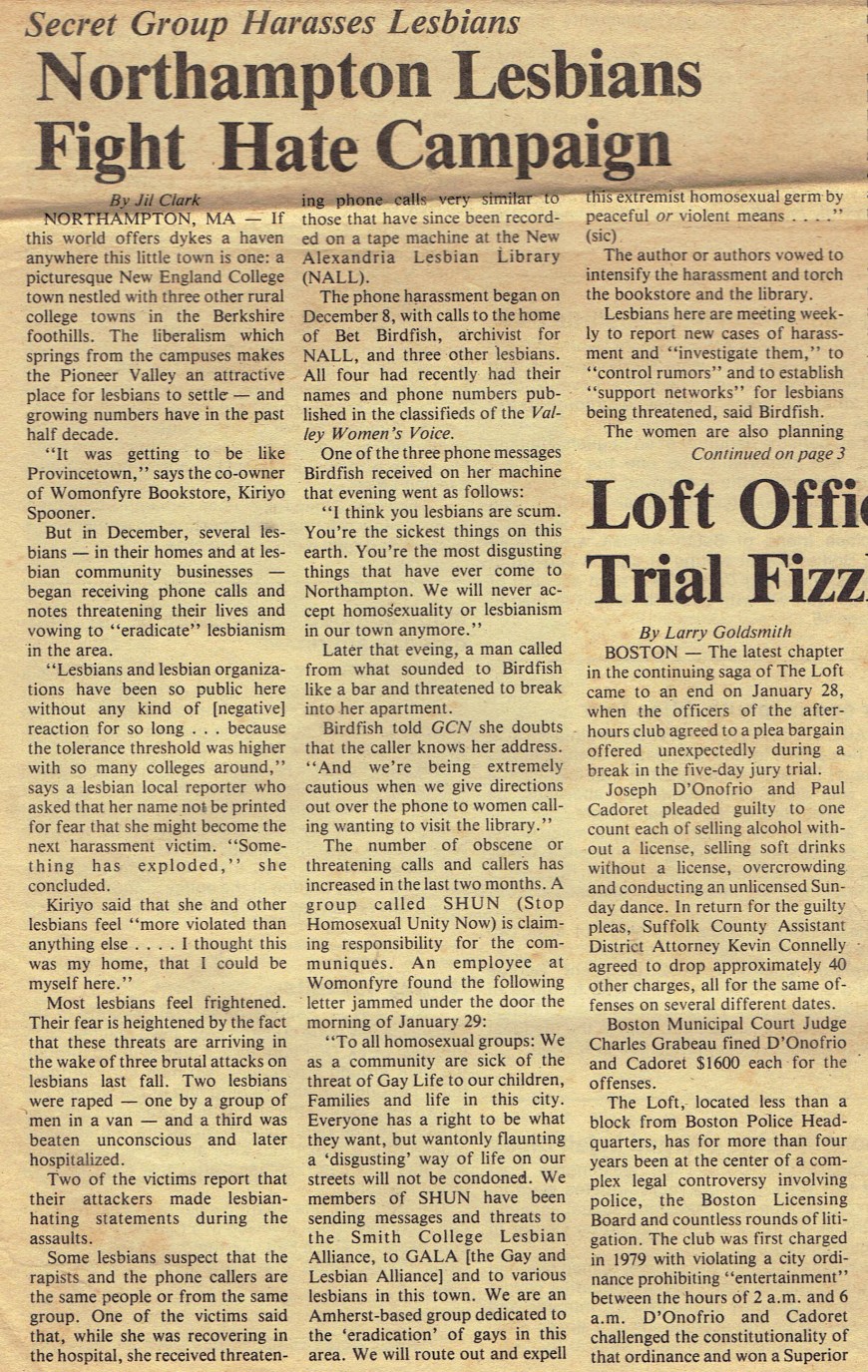 Gay Community News. Boston, MA. Feb. 12, 1983
Meeting With the Mayor: Feb. 1983
City officials appeared ignorant of the repeated reports being made to the Northampton Police. When it was finally brought to the attention of Mayor Musante, he suggested a meeting with community representatives to discuss the issue. After various negotiations, a Feb. 8 meeting took place at Memorial Hall. About 200 community members met with Musante, the Chief of Police, the District Attorney, and the acting Editor of the Gazette to present testimony on the campaign of intimidation and demand action. Outside another 100 people – holding signs that read “Stop the Violence! No More Silence!”—held a vigil in support. They stood on the lawn of the Unitarian Society since the group had been denied a permit to rally in Pulaski Park.
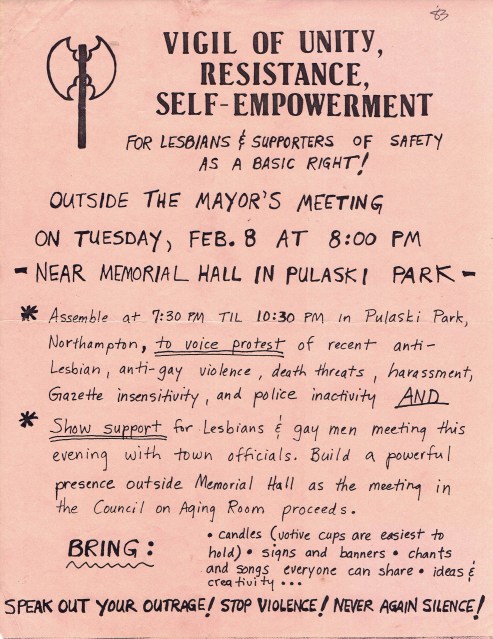 flyer vigil Feb 8, 1982 Northampton, MA
Over the objections of the DHG, the meeting in Memorial Hall was “off the record” to prevent outing those offering testimony about what had been occurring over the last six months.
Opening Statement reprinted in the Valley Women’s Voice March 1983
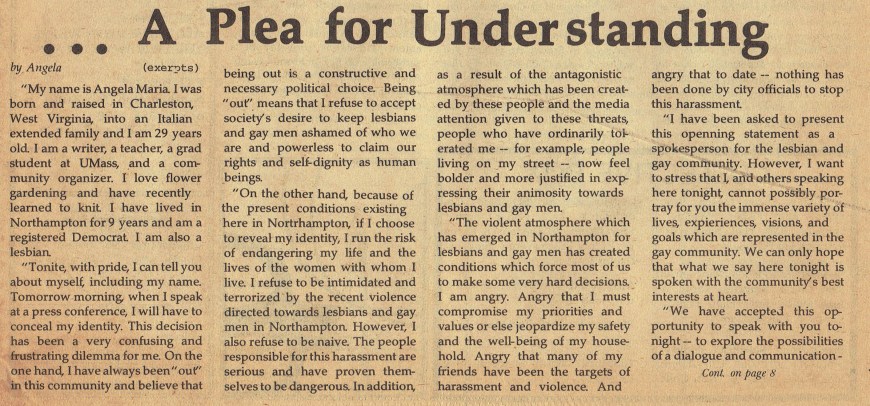
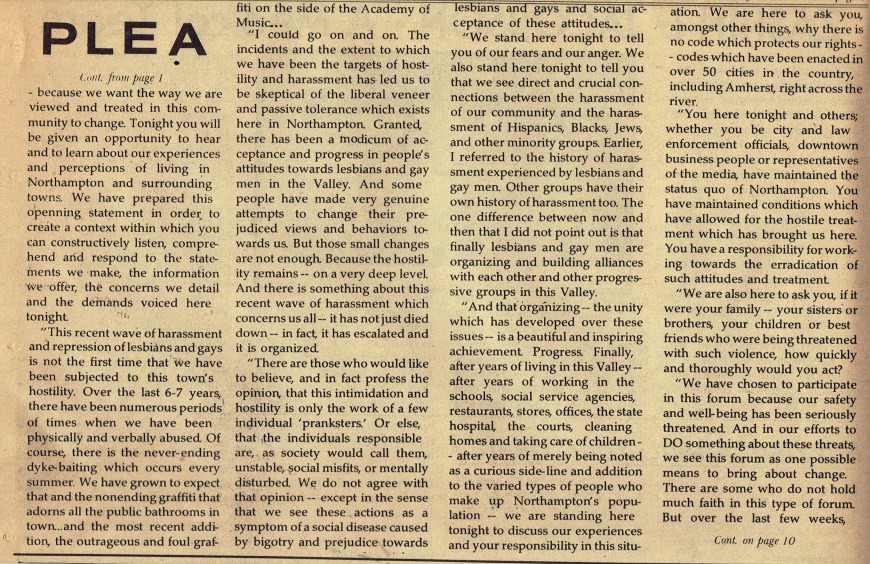
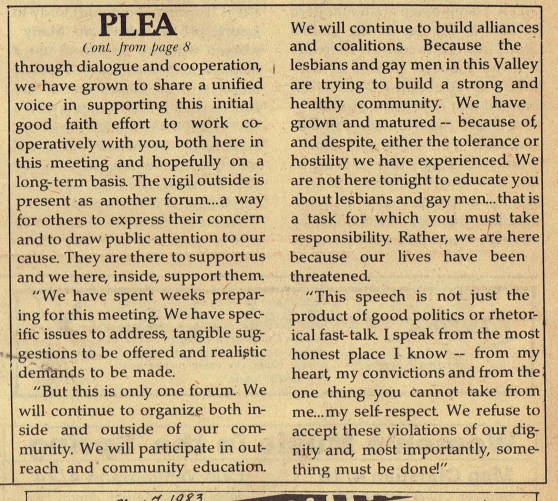
A list of sixteen demands for action were presented, including immediate public statements from the Mayor, DA, police, and DHG opposing the violence; coordinated police action in cooperation with the community to investigate and end the crimes; the end of “libelous” coverage in the DHG; the formation of a Mayor’s Task Force to address the harassment; the Mayor’s endorsement of the upcoming Lesbian/Gay Liberation March; and a City Ordinance prohibiting discrimination. A group of males harassing people leaving the meeting had to be told by police to leave the area of Memorial Hall.
At a press conference the next day, Mayor Musante and District Attorney W. Michael Ryan issued statements denouncing the threats and violence. A Mayor’s Task Force with city officials, four Lesbians, and two gay men was set up. On his own initiative, Ward 2 Councilor William Ames introduced a measure to the City Council condemning the violence. This was defeated by a tied vote of the Council.
Activism Expands Along With Backlash
For several weeks after the Mayor’s meeting and resulting newspaper coverage, threatening calls subsided a bit. Even as the next March was being organized, GALA formed a Human Rights Ordinance Committee to begin drafting an anti-discrimination ordinance similar to the one that had been in place in Amherst for a number of years. After a mid-March story on Womonfyre Bookstore appeared in the Gazette, however, murder and arson threats began anew. Additional targets now included the Valley Advocate, which had printed a letter from GALA, and Valley Women’s Martial Arts, which had hosted the Lesbian community meetings. In the weeks leading up to the March, SHUN repeatedly phoned, threatening violence at the event, and shouted the same at two Lesbians on the street. At least five times, volunteers put Womonfyre under 24-hour protective surveillance in case the specific new threats of arson were carried out.
The second, now officially named, Gay and Lesbian Rights March was scheduled for the second Saturday in May, the 14th, 1983.
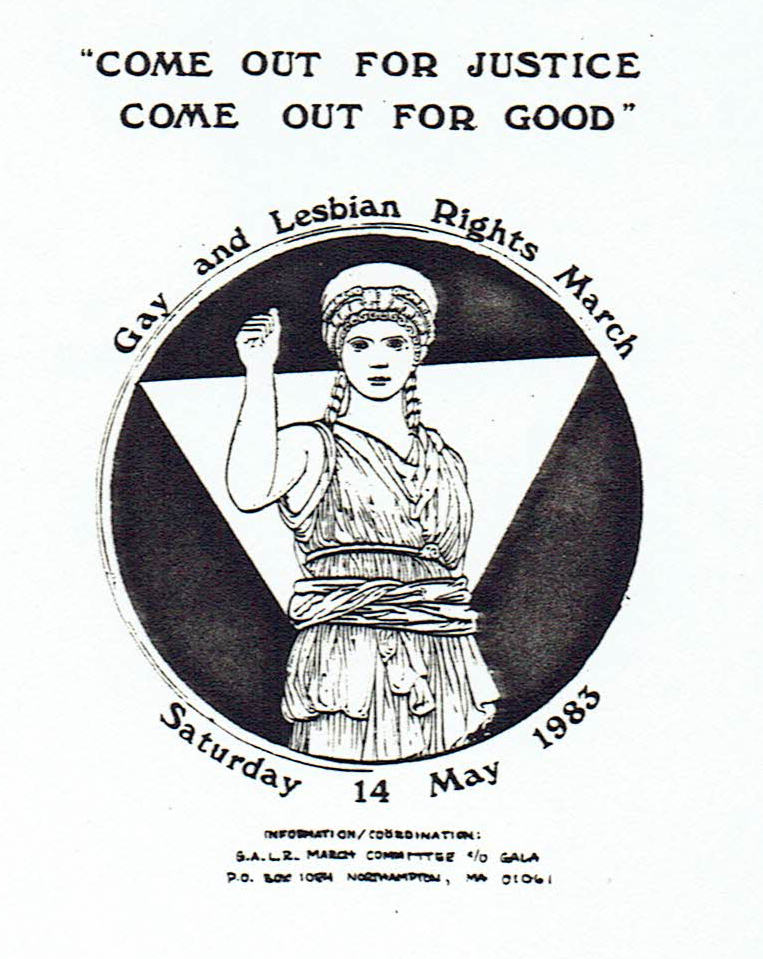
Coming next, an account of the second march. To get an email notice when that post is published add your email address under the (free) subscribe button.
Sources:
__ undated flyer (1978?) for an initial meeting to organize a Lesbian/Gay Rights march in Springfield.
__“Cruising” Boycotts Underway. Valley Women’s Voice. March 1980. https://en.wikipedia.org/wiki/Cruising_(film)
__”Womonfyre Womyn Harassed.” Valley Women’s Voice. Northampton MA. Sep. 1980.
__Northampton Law Collective. “Women and the Law.” Valley Women’s Voice. Northampton MA. May 1982
__”Why Lesbians should Register to Vote. Flyer. August 1982.
__Grossholtz, Jean. “Open Letter to Lesbians.” Valley Women’s Voice. Northampton MA. Oct. 1982.
__”WARNING: RAPE ALERT.” Valley Women’s Voice. Northampton MA. Oct. 1982.
__”Town Mothers Impose Curfew.” Valley Women’s Voice. Northampton MA. Nov. 1982.
__”March Against the Klan.” Valley Women’s Voice. Northampton MA. Dec. 1982.
__”NALL Threatened.” Valley Women’s Voice. Northampton MA. Dec. 1982.
__Dyke, Ima. ”Lesbian Community Harassed.” Valley Women’s Voice. Northampton MA. Feb. 1983.
__Thomas, Lou. Letter to the Editor. Valley Advocate. Hatfield MA. Feb.2, 1983.
__ “Death threats, Harassment Continues…Community Resistance On the Rise.” Mimeographed information sheet, #3. New Alexandria Lesbian Library. Northampton MA. Feb. 2, 1983.
__Fitzgerald, Maureen. “City officials, gay community [scheduled to] meet.” Daily Hampshire Gazette. Northampton MA. Feb. 8, 1983.
__”Public vs. Private.” Editorial. Daily Hampshire Gazette. Northampton MA. Feb. 8, 1983.
__”Vigil of Unity, Resistance, Self-empowerment.” Flyer. Feb. 8, 1983.
__”Orientation and Unity Statement for the Lesbian and Gay Community. Northampton, February 8, 1983.” Four page mimeograph includes agenda for the meeting with the Mayo and other officials and the sixteen demands.
__Fitzgerald, Maureen. “Members of gay community detail threats, harassment.” Daily Hampshire Gazette. Northampton MA. Feb. 9, 1983.
__Mosley, Lisa. “200 gays and lesbians tell officials to make Northampton safer for them.” Massachusetts Daily Collegian. Amherst MA. Feb. 10, 1983.
__Clark, Jil. “Northampton Lesbians Fight Hate Campaign: Secret Group Harasses Lesbians.” Gay Community News. Boston, MA. Feb. 12, 1983.
__Bradley,Debra. “City Council ballots to a tie over anti-violence measure. Daily Hampshire Gazette. Northampton MA. Feb. 18 1983.
__Colfer, Kim. “A Call For Action.” Valley Women’s Voice. Northampton MA. March 1983.
Angela. “A Plea for Understanding.” Statement read at the meeting with the Mayor. Valley Women’s Voice. Northampton MA. March 1983.
__Boysen, Sherman. “Organizing in Northampton: Assessing the Results.” PVPGA Gayzette. Northampton MA. Mar. 1983.
__Unger, Bob. “Lesbians stake out lives in usually tolerant [missing end].” Daily Hampshire Gazette. Northampton MA. Mar. 12, 1983.
__ Fitzgerald, Maureen. “Ordinance wanted to ban discrimination.” Daily Hampshire Gazette. Northampton MA. Mar. 16, 1983.
__Lootens, Tricia.”Northampton Lesbians Unify Against Threats.” Off Our Backs. Washington D.C. March 31, 1983.
__”Anti-discrimination law discussed.” Daily Hampshire Gazette. Northampton MA. Apr. 5, 1983.
__Spooner, Kiriyo. Letter to the VWV. Valley Women’s Voice. Northampton MA. May 1983.
__”Harassment Continues.” PVPGA Gayzette. May, 1983.

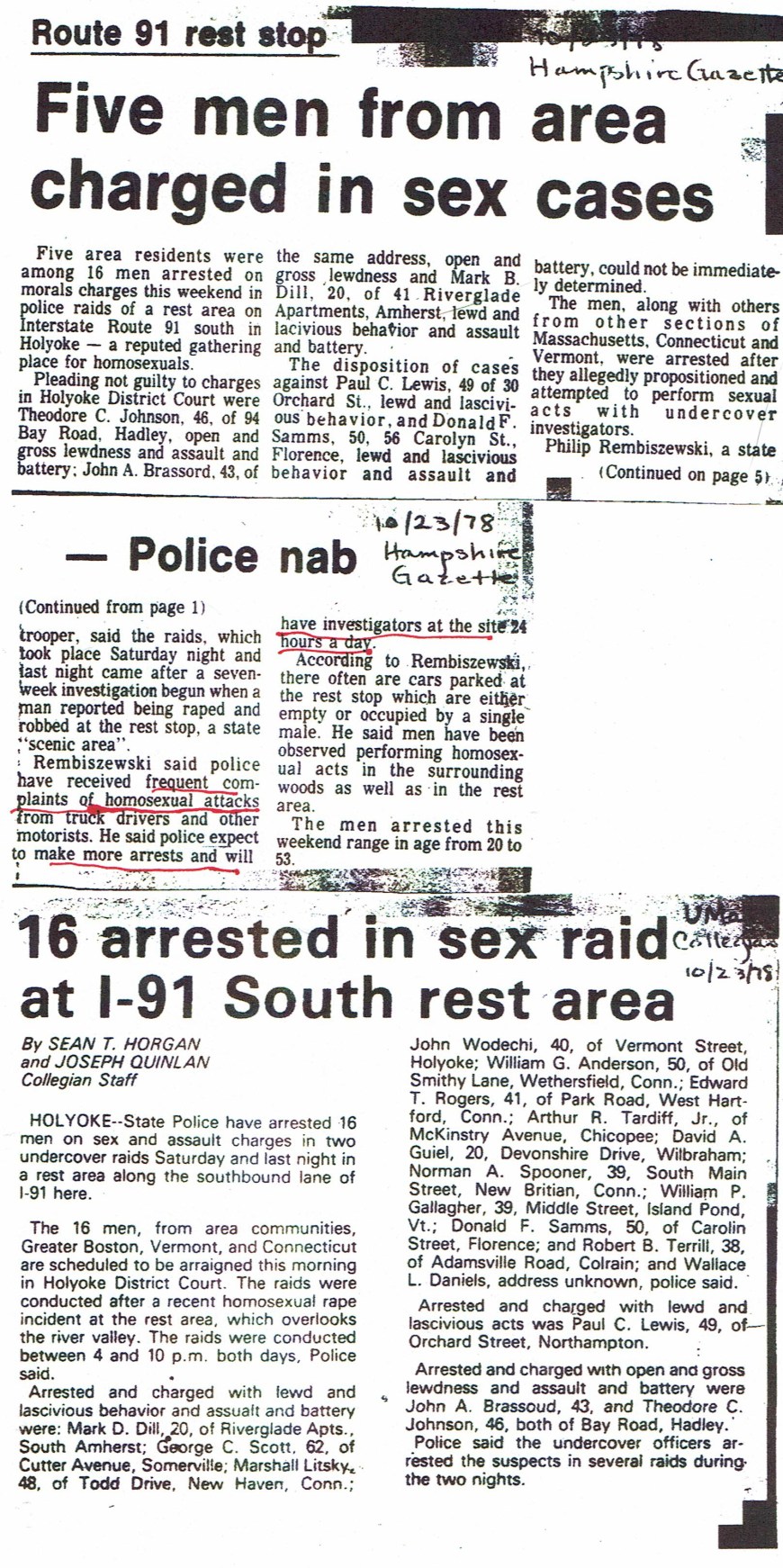 Daily Hampshire Gazette, Northampton MA and UMass/Amherst Massachusetts Daily Collegian coverage Oct. 23, 1978
 Springfield (MA ) Union Oct. 24, 1978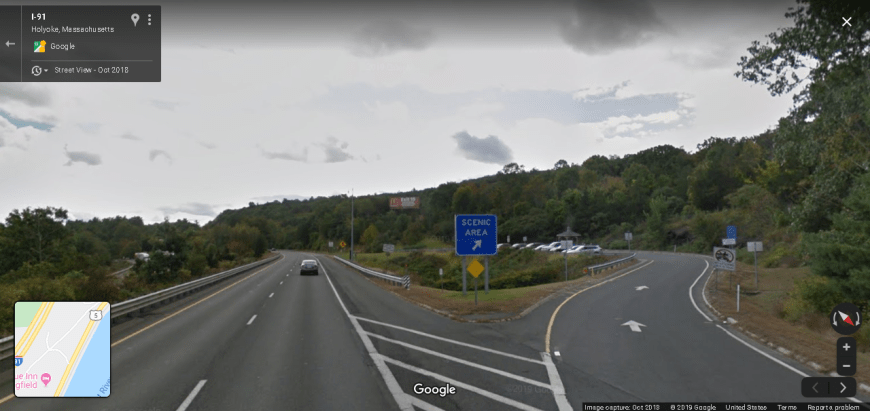
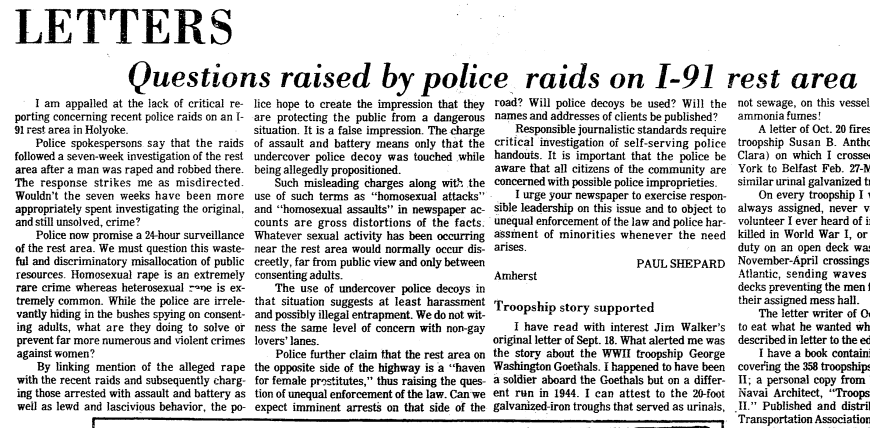 Springfield Union Nov. 1, 1978.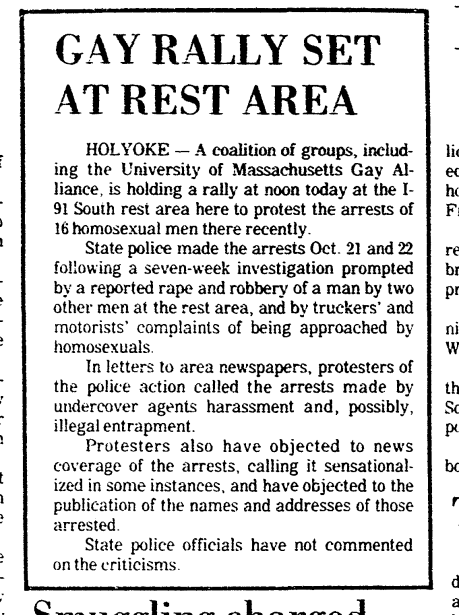
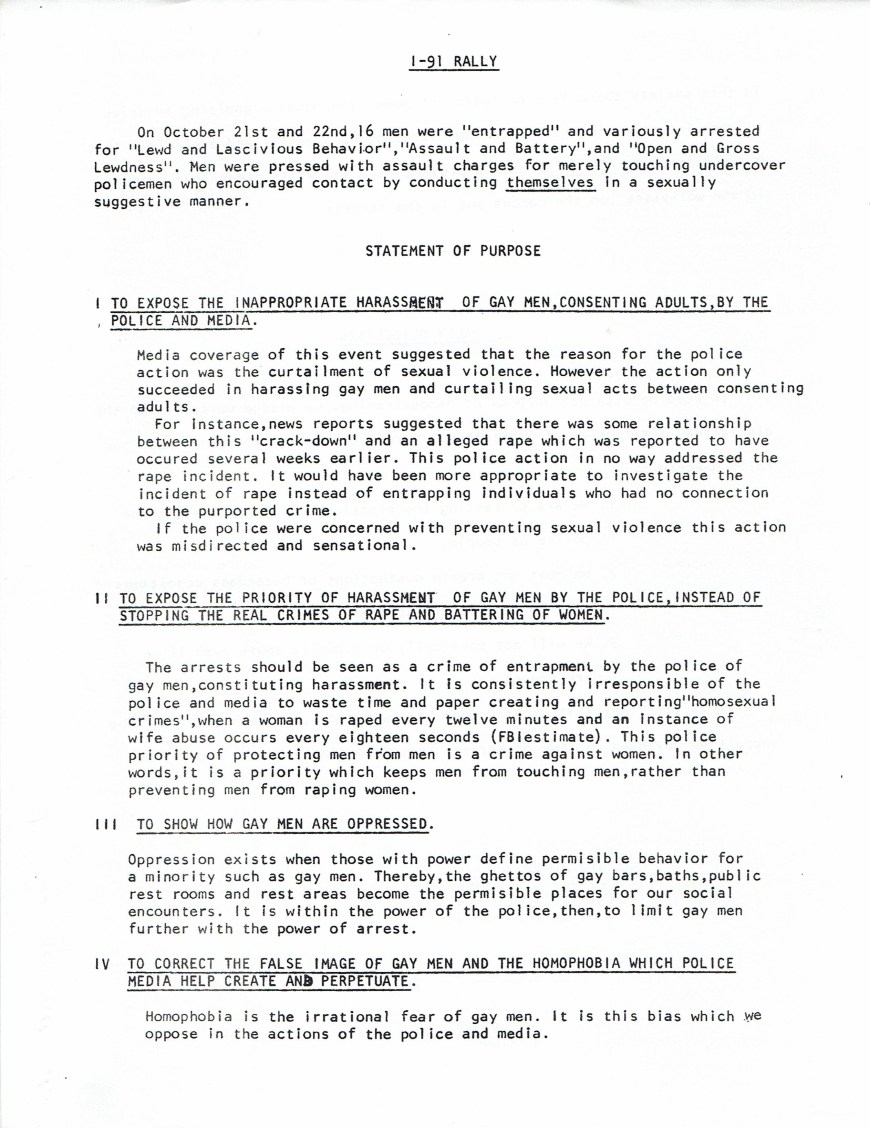 Flyer distributed Nov. 5, 1978, mimeograph one of two sides, courtesy Bambi Gauthier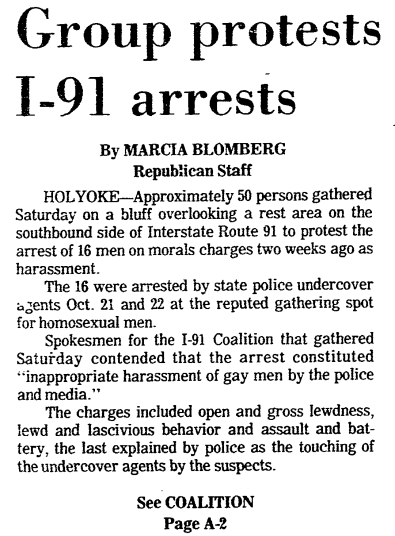
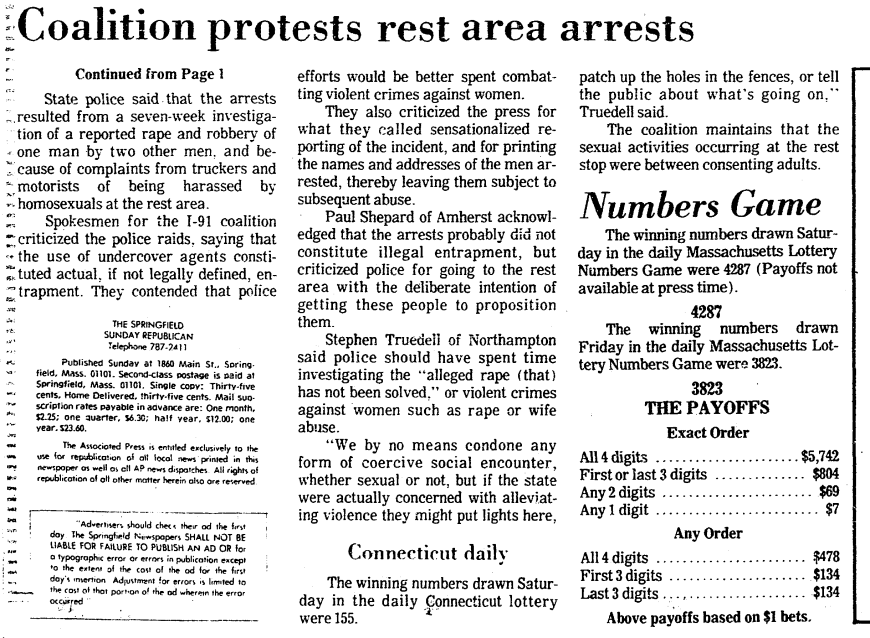 Springfield Republican Nov. 4, 1978.
 From Wicked To Wedded