A Faux Girl Scout…


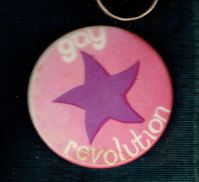
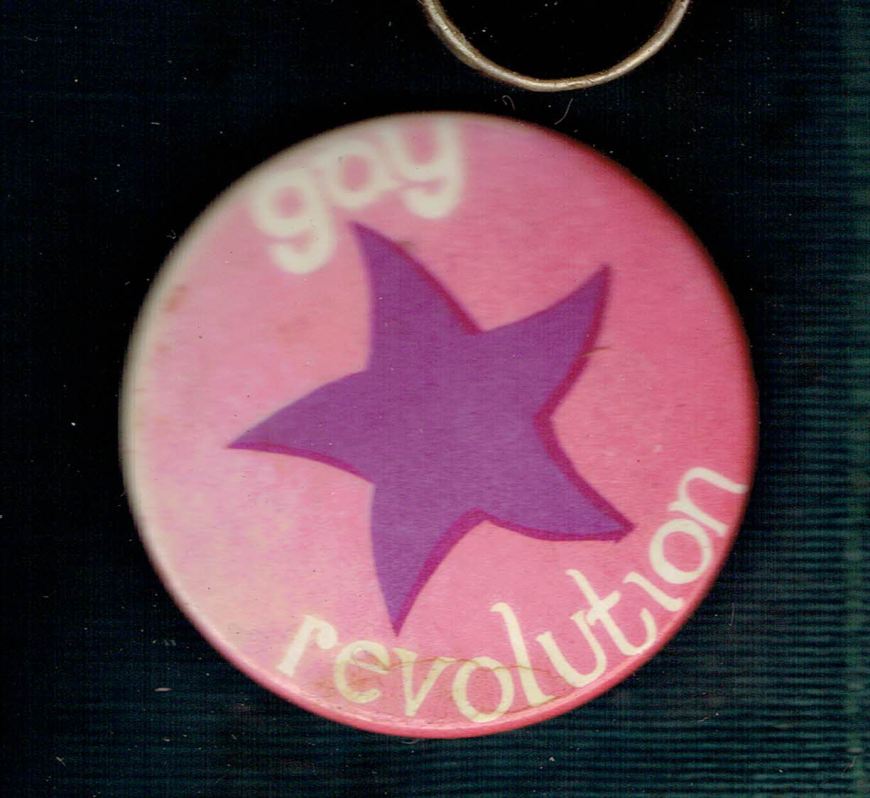
Susan Stinson had asked the source of the button I used to illustrate the last post. I explained that I had brought it back from the second (1971) Stonewall March in NYC and, for the blog, scanned it  in button gay revolution 197103202015situ_pinned to my faux Girl Scout badge sash. The dark green cloth is visible background. In response to her curiosity about the sash I brought it to show  at our most recent meeting. My wonderful writing coach asked to see it worn and appreciatively snapped the photo below.
The faux sash was custom sewn for me by Marguerite “Peggy” Cookson. We were both living at Green St. in the mid-late 70s and I had begun to organize my overflow of papers into scrapbooks. There were a significant number of objects that rubber cement wouldn’t work on. Having once been a Girl Scout I re-imagined the traditional badge sash as a larger life reflection .

As Susan said in her original post of it on facebook, “Kaymarion Raymond wearing the most amazing Girl Scout sash ever, covered with tokens and buttons from her adventurous life, including all sorts of old political buttons, feminist and presidential, both; her dog tags; keys from the old boarding house on Green Street and many other very cool items. We were meeting to go over work on her history of queers in the Valley. She’s got great stuff coming up.”
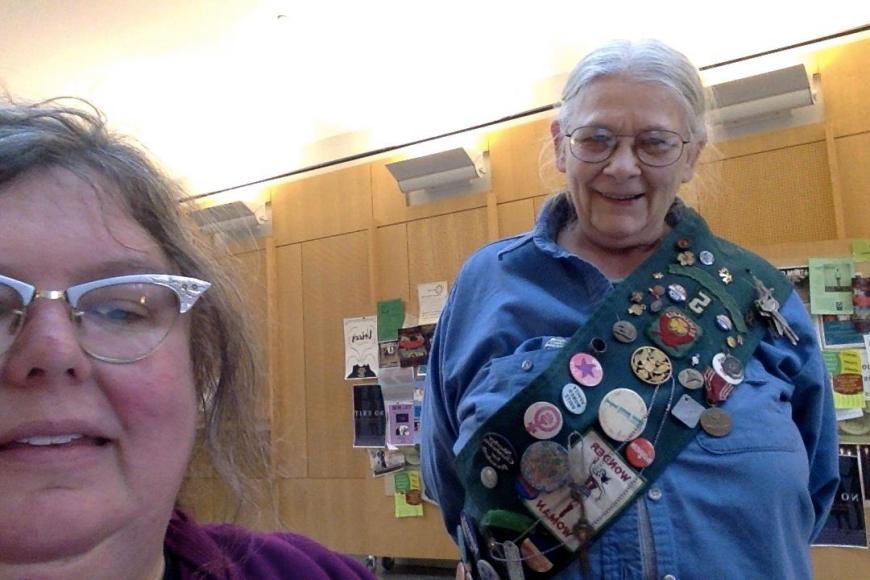
girlscout sash by susan

Thank you Susan. I note that mysteriously, to me, her computer camera takes reversed pix. And speaking of stuff, coming soon will be an overview of the 1970s in Lesbian and Gay Northampton with a hot pink timeline that also caught her eye. Smile.
 

A Revolution of Sorts


The friction of contradictions fire the crucible out of which Northampton community formed.” This sentence is how historian Kerry Buckley introduced Historic Northampton’s 2004 update of the city’s story, A Place Called Paradise ”The dynamic between factions_ newcomers and old-timers, Yankees and immigrants, young and old, has always been part of the creative tension that, at its best, has enlarged the community’s capacity for tolerance.”

Add LGBTQ peoples to Buckley’s list of contrary factions. LGBTQ peoples in large numbers came to, or came out within, Northampton starting in 1970, creating friction both in the town and amongst themselves. Peoples, in the plural, because it has been successive waves of differently-identified persons who have emerged, come out, gathered, organized, agitated, advocated, and created on their own behalf. There have been multiple peoples over more than four decades, with little in common except an outlaw status — outside heteropatriarchal marriage (until 2004) and stigmatized — that has formed the basis for occasional coalition and a more mythical community.

LGBTQ people were here in Northampton all along, just not visible until starting in the 1970s various populations, sequentially, came out to each other swelling to a critical mass  that allowed for  organization. Lesbians; then gay men; then their parents; add queers and bisexuals, here come transsexuals, and transvestites; don’t forget young people; how about spouses or significant others? Each newly emerging group defined themselves, voiced their needs to each other, and added unique solutions to respond to those unmet needs. Each group spun themselves into the fabric of a subculture that gradually became more visible on Main Street. Chief among the needs for each group of people have been safe and supportive ways to meet each other, and, as increasing numbers of people came out and met, new groups or activities formed to meet increasingly specific needs.

Collectively (and fractiously) growing in strength over time, the activity centered in Northampton often provided an organizational nexus for all of Western Massachusetts. The long-lived and most visible LGBTQ cultural institution, the annual March/Parade (under varying names), began as a coalition for change in Northampton, reflected the shifts in politicized populations over time, and became a forum of expression for all of the region. As part of a state and national movement of change, a loose alliance of groups centered here helped bring new civil liberties in the state as well as inclusion in the politics of the municipality.

Some would say an integration of sorts has been achieved by these LGBTQ peoples, with many needs now met by mainstream institutions, and visibility largely unremarked upon in most parts of town. There is a record of groups forming and then falling away over time, but was that because they were no longer needed? The reasons for this could be explored in this blog, as well as a search for any lessons about creating change that can be applied to this new era. And still to be painted is a portrait of Northampton LGBTQ (add the latest initial) today, to hold up in comparison to that of the 1960s isolation. What has stayed the same? What has changed? What still is needed? Who is going to create something to fill that need? And can history hand them some tools to do it with?

COMING NEXT: An Overview of the 1970s.

button gay revolution 197103202015
button I brought back from Christopher Street March NYC June 1971


Throw Back Halloween


I am just starting to draft copy about the many women’s bands that played in Northampton in the 1970s and came across this Halloween at the Rusty Scupper in Amherst where the Deadly Nightshade was playing. That’s me in drag, sitting with Liz Knowles and Nancy Schroeder. Photo courtesy of Pamela Brandt of the Deadlies.

km halloweenrusty scupper,w l knowles, DNS n schroede 10222015

Just Before the Revolution


Was there a gay revolution in Northampton? A look at the gay subculture that existed here just before 1970 may help answer that. I am still looking for and surveying existing literature but here’s a summary of one piece of research.

Lack of documents is one thing noted by Vincent Bonfitto in his 1990 search for Valley gay history prior to the modern gay and lesbian political movements. Only by interviewing seven older gays and lesbians (all of whom may have been white), including Warren Clark and Jean Grossholtz, for his Master’s thesis at UMass was he able to add a little to our sparse knowledge of post-WWII Valley gay subculture.

In general he found this subculture was largely limited to very private social networks meeting in each others homes; and, often isolated individual couple relationships. Gays and lesbians in this era often had to go out of town to find venues for meeting each other. The experiences of men and women and their subcultures differed in significant ways.

Those interviewed by Bonfitto noted that social life for gay male academics centered around private Smith College cocktail parties and trips to Jacob’s Pillow dance center in  Becket MA in summer. Gay male social life was absent at Amherst College, where a gay male faculty member had been asked to resign in the 1950s. No information was included on UMass, except that couples existed. One social network consisted of gay priests in the diocese. Three of the four men interviewed had lost jobs because of homosexuality, one not rehired at Amherst High School in 1962 for, among other things, being “effeminate.”

Gay men in the Valley cruised public facilities for anonymous sex in Amherst, Holyoke, and Greenfield, as well as Northampton. The largest cruising grounds familiar to the men were in Springfield, including the lobby of the Bridgeway Hotel, a huge public men’s room next to City Hall, and the park behind Old First Church off Court Square.

The nearest gay bars were also in Springfield. Though they occasionally were visited by gay women, they were largely for men, with varying clientele. The fourth floor bar and restaurant Blakes was run like a private club, very “high class,” and had drag balls during the holidays. The Arbour was a formal, “posh” piano bar for the over-thirty crowd, while the Arch and Sports Lounge were more informal and mixed class. The Arch, in particular, was known as a pickup place. Bonfitto doesn’t mention the race of bar patrons, the location of the bars, or dates of existence.

Gay women’s or lesbians’ culture appears to have been much more restricted and largely separate from the men’s. Throughout his thesis, Bonfitto refers to the women as “lesbians,” with no note of the actual self-referents of those he interviewed. The three women noted very closed social networks, little bar attendance, but the known existence of a reputed butch-femme bar culture with alcohol-fueled violence. At Mt. Holyoke College, students who came out (were discovered) were moved by the administration to live by themselves in single dorm rooms or off campus. The only alternative to the Springfield bars mentioned above, for women,  was attendance in Boston at Daughters of Bilitis events and vacationing in Provincetown.

Aside from Bonfitto’s thesis there are a few other published sources I have yet to review that contain bits about this period. Some scraps have come my way. I was told by a Smith College alumnae who came to live at Green Street in the early 70s that she had been suspended for a semester and sent home to get psychiatric treatment because her feelings for another woman became apparent to others.

In 1969, among the many old WAC friends who visited my partner Susan and me in Williamsburg, was a gay female couple then living in New York. They brought the portentous news that one of them was transitioning to male. Because of Susan’s regular correspondence with Ladder editor Barbara Grier, our friend Karl (literary pseudonym) wrote what may have been the first article on transsexuals published by the magazine. In 1972, the couple, now legally married and with an adopted child, moved to Northampton and totally assimilated.

The Ladder Apr/May 1970. Written by a transsesexual who moved to Northampton in 1972 with his wife and child.
The Ladder Apr/May 1970. Karl (a literary pseudonym) moved to Northampton in 1972 with his wife and child.

The semi-rural nature of the Valley and the generally small size of towns, even those with academic institutions, undoubtedly contributed to the very private and often isolated existence of gay people in Northampton and the area prior to 1970.

What began to change and how it happened are the topics of the next series of blogs on the 1970s. I am very much looking forward to getting my personal copy of Lillian Faderman’s new history the Gay Revolution. It’s been given fine reviews and I’m sure, like the other volumes I have of her work, I will underline, highlight and scribble madly in its margins. A timely publication that can be referred to as we lay out the story of the revolution here in the Valley. Stay tuned in!

COMING NEXT: A Kind of Revolution: Overview.

SOURCES:
__Bonfitto,Vincent F. “The Formation of Gay and Lesbian Identity and Community in the Connecticut River Valley of Western Massachusetts, 1900-1970.” Journal of Homosexuality, Vol. 33(1) 1997, 69-96. Haworth Press. I will include more material in future blogs.
__Ericsen, Karl. “The Transsexual Experience.” The Ladder, Apr/May 1970, 25-27. Daughters of Bilitis, San Francisco.

FUTURE WORK? LOOKING FOR: I have also been told about, but not yet verified and researched, semi-pro women’s baseball and basketball teams in Springfield, and a Valley-wide industrial women’s softball league that may have existed in the 1960s. Who knows about this? Also were there male equivalents? Or bar leagues as have been found in other large cities? Does anyone know the location of the Springfield bars mentioned by Bonfitto, or (pie in the sky) have photos? I will post a blog soon on the Girls Club, lesbian bar in Chicopee started in the 1940s.

Scraps of the Past


In 2004 Mark Carmien, owner of Pride and Joy (the LGBT gift and book store on Crafts Avenue in Northampton at that time), got a phone call from a man saying that his gay uncle had died and in cleaning out the deceased’s home he had found some memorabilia. What, the caller wondered, should he do with it?

Carmien got in touch with Northampton’s unofficial gay archivist, Phil “Bambi” Gauthier, who collected the box of material dropped off at the bookstore. The box contained gay erotic magazines and several albums of undated color Polaroid photos.

These photo records, though undated, would probably have been from 1965 or later. Polaroid color cameras first became available in 1963, and they released their most popular low priced “Swinger” model in 1965. One obvious benefit of these cameras was cutting out the need to have the photos developed by someone else, and risk censorship or worse for any erotic content.

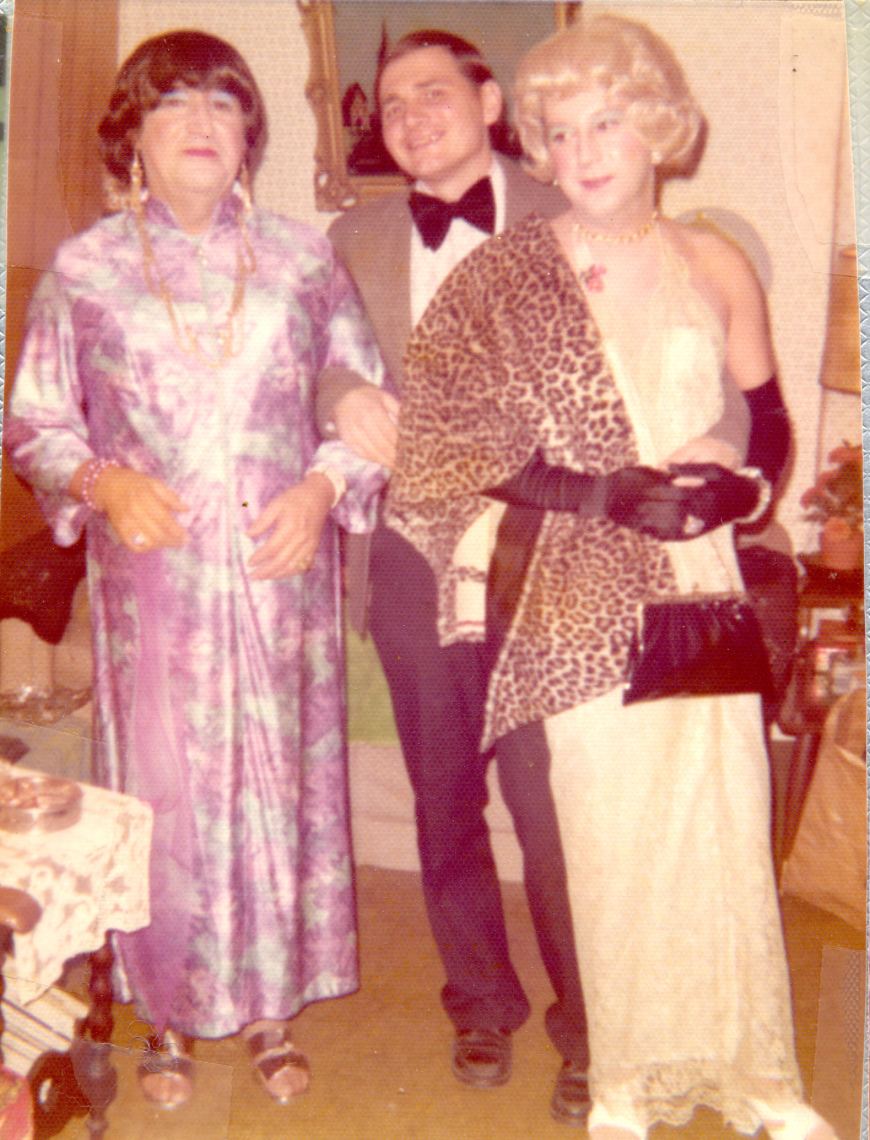
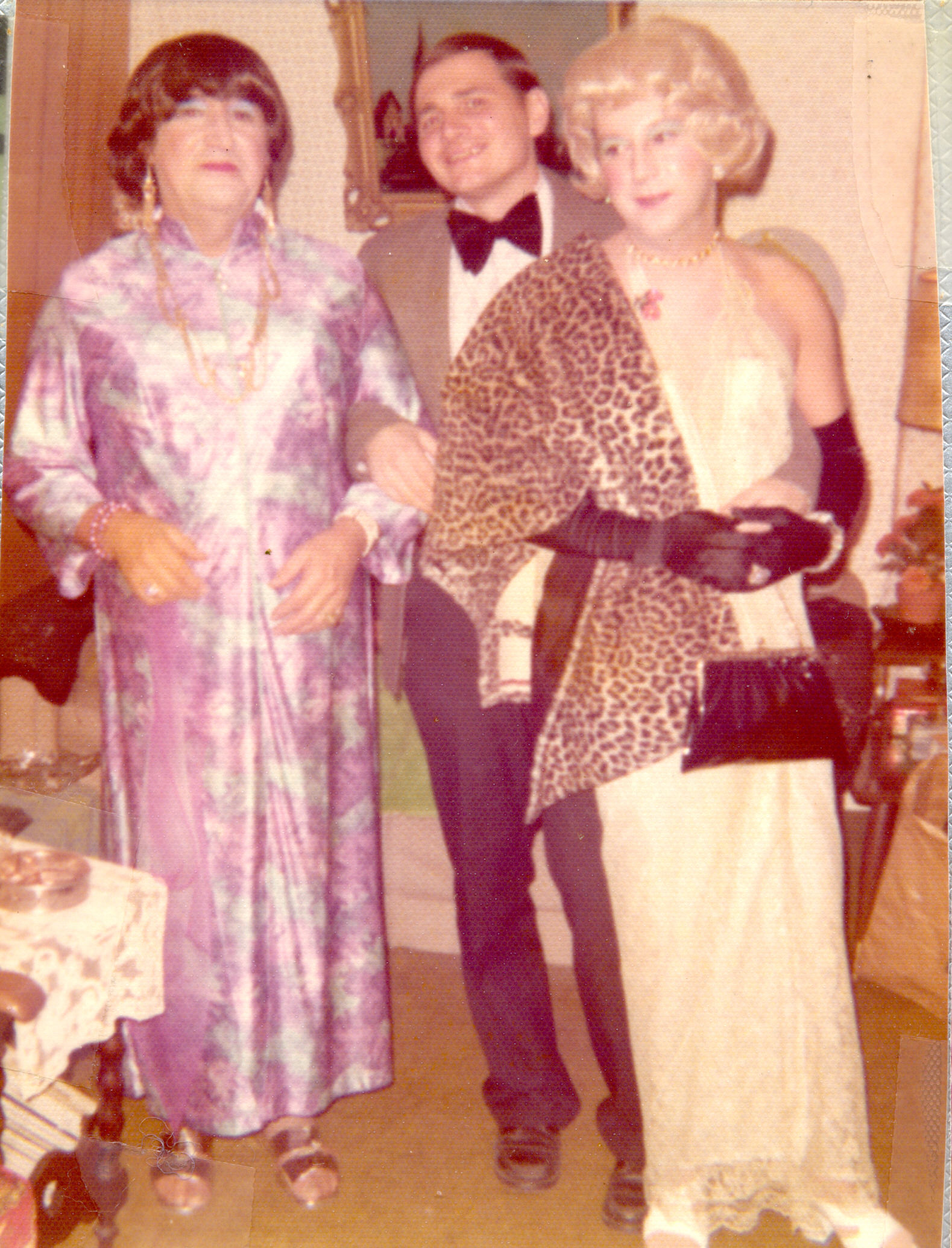
Two of the albums passed to Bambi were filled with no-face-showing close-ups, obviously in a private home, of erections and asses. As he leafed through the third album, browsing the selection of candid but more clothed snapshots from many home parties held or attended by the Springfield man during the 1960s and 70s, Bambi came across several snapshots of his own “grandmere,” R. Warren Clark, dressed as Sophie Tucker.

“Sophie Tucker” Warren Clark (on right) of Northampton at a drag party with unidentified escort, probably in Springfield during the late 1960s or 1970s. Source: Phil Gauthier collection

In 1987, the then-nineteen-year-old Gauthier had decided to join the local chapter of Integrity, and asked two Northampton gay “elder statesmen” to stand as his baptismal godparents. The two men, Warren and Ralph Intorcio, had for decades been part of a small circle of gay male friends who met regularly for little suppers. Many worked at the VA Hospital in Leeds, and were married with children, sharing their gay life only very privately with each other.

Interviewed in 2004, Bambi remembered Ralph coming home several years after his baptism with a few boxes belonging to one of those men. The friend had just died and, as per the contract this small group had with each other, Ralph used the key he had been given to go into the deceased man’s home and remove anything indicating his secret life before relatives might discover it. Bambi remembered getting brief glimpses of that secret life as he handed letters of WWII and Korean War soldiers—along with photos of them arm-in-arm, many with cheeky and loving notes on the back–to his godfather who fed them into a fire in the woodstove on the summer porch. Seeing this history disappear was one of the saddest things Bambi had ever witnessed.

Fifteen years later, because of a thoughtful nephew, Gauthier had a piece of the past that usually got destroyed. Most of us don’t think about the fact that as we live, we are making history. We don’t think about the history books that can be written only based on whatever documents have been saved or memories have been recorded. In recent decades many people have moved away, taking with them group records, flyers, news clippings and correspondence. Others have thrown out journals, letters or scrapbooks. Many boxes of documents are moldering in basements, attics, or garages.

SOURCES:
__Gauthier, Phil “Bambi.” Conversations with, Sep.2004, Northampton, Mass.
__http://polaroid.com/history  .

__Sophie Tucker, last of the “Red Hot Mamas”; very lovely tribute video on Youtube https://search.yahoo.com/yhs/search?p=sophie+tucker+video+biography&ei=UTF-8&hspart=mozilla&hsimp=yhs-001

__Integrity is a group within the Episcopal Church for LGBT people, formed nationally in 1975. The local chapter is St. John’s on Elm Street, founding date and other history still unknown. Do you know?

COMING NEXT: What else is currently known about Northampton’s gay world just before the revolution, the beginning of lesbian and gay political activism in 1970? Watch for Scraps of the Past part two surveying research literature as well as more personal anecdotes.