Woman of the Year 1964: Barbara Gittings


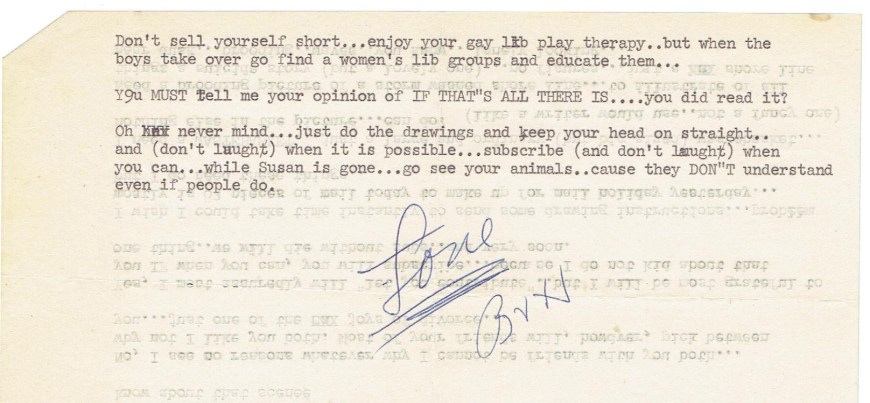
Little notes, typed on Dictaphone paper, used to come in the mail for me and my partner Susan. The scribbled initials on each were those of the editor of the Ladder and, sometimes, her partner Kay. Through such brief, dashed off, means she gathered news, reviews, stories and ,yes, illustrations from hundreds of gay women across the country to publish in this sole U.S. lesbian magazine. Two of my blog posts detail a few of my early interactions with Barbara Gittings. Time Magazine’s tribute to unsung women was an appropriate start to this Women’s History Month. It feels, at a time frozen in pandemic, an appropriate reminder of resistance to end this month of March with her cover and Michael Bedwell’s tribute as shared to OutHistory.
Image may contain: 1 person, eyeglasses and text
Michael Bedwell

GAY RIGHTS PIONEER BARBARA GITTINGS’ SURVIVING PARTNER of 46 years Kay Tobin Lahusen called me yesterday to alert me to Barbara’s inclusion in “TIME” magazine’s 100 Women of the Year project. They commissioned 89 new “TIME” mock covers to commemorate 89 women who should have been on the magazine’s covers over its near century of existence. The remaining 11 are existing real covers of women who had been named Person of the Year.

BARBARA’S cover used a 1964 photo by Kay rendered by Serbian artist Ivana Besevic, and incorporates the motto “Gay Is Good” coined in 1968 by Barbara & Kay’s close friend and mentor Frank Kameny, the father of the modern gay rights movement. The accompanying text by “TIME’s” San Francisco Bureau Chief Katy Steinmetz reads:

“The Stonewall riots have become the focal point of the modern LGBTQ-rights movement, but they didn’t start it. The groundwork was laid in the previous decade by activists like Barbara Gittings, who understood that before marginalized people can prevail, they must understand that they are worthy and that they are not alone.

In an era when it was dangerous to be out, Gittings edited the Ladder, a periodical published by the nation’s first known lesbian-rights organization, the Daughters of Bilitis, creating a sense of national identity and providing a platform for resistance. In the August 1964 issue, her editorial blasted a medical report that described homosexuality as a disease, writing that it treated lesbians like her more as “curious specimens” than as humans.

Gittings would go on to be instrumental in getting the American Psychiatric Association to stop classifying homosexuality as a mental illness and in getting libraries to carry gay literature. Whether she was wielding a pen or a protest sign, the militant advocate had a simple message: when society said that being gay was an abomination, Gittings said that gay was good.”

Prints of the illustration are available at: https://fineartamerica.com/…/barbara-gittings-1964-time.html

Barbara was memorialized in 2012 along Chicago’s Legacy Walk, the world’s first outdoor museum of LGBT history. SEE: https://legacyprojectchicago.org/person/barbara-gittings
Men Protest 


 “It was scary,” Steve Trudel recalls, “but the police action and media reports were so outrageous that even though I wasn’t into cruising rest stops myself, I was moved to do something about it.”

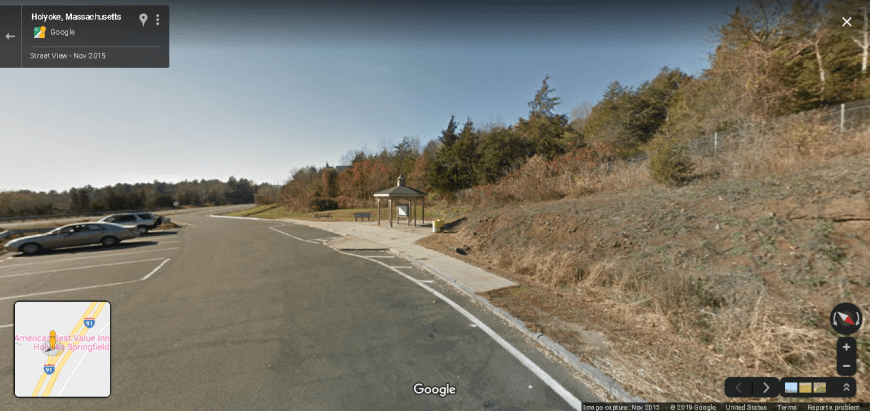
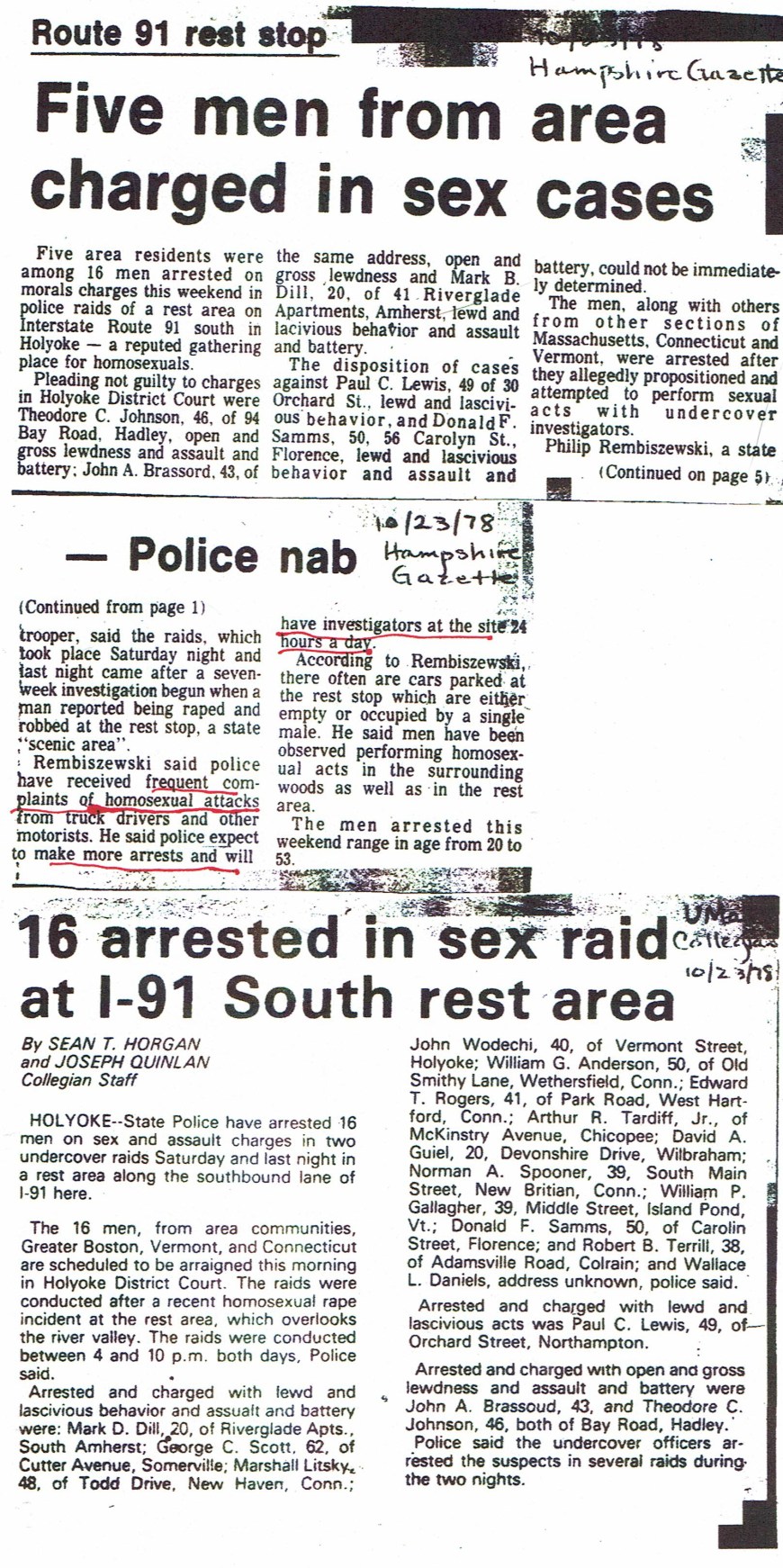
Steve lived in Northampton in the late seventies. He and other men were galvanized into protest by October 23-24, 1978 newspaper accounts of a sting operation at an Interstate 91 rest area in Holyoke in which sixteen men were arrested for soliciting casual sex. The names and addresses of those arrested—along with the “morals” charges made against them –were widely reported in area newspapers, including the Daily Hampshire Gazette and the UMass Daily Collegian.

DHG MDC Oct 23 78_edited-1Daily Hampshire Gazette, Northampton MA and UMass/Amherst Massachusetts Daily Collegian coverage Oct. 23, 1978

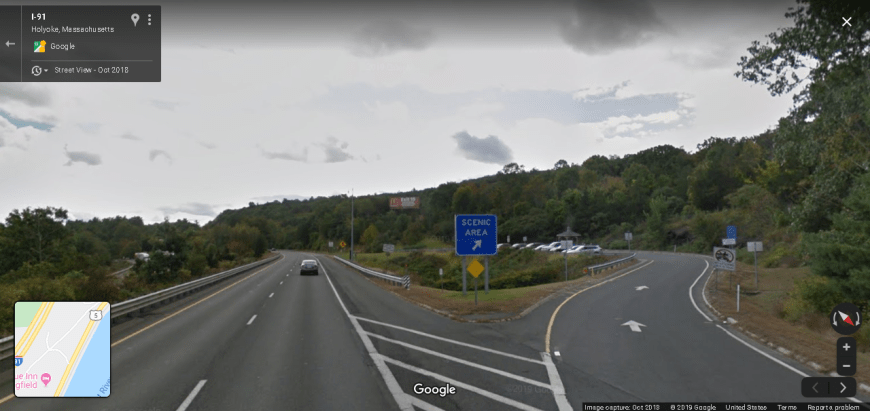
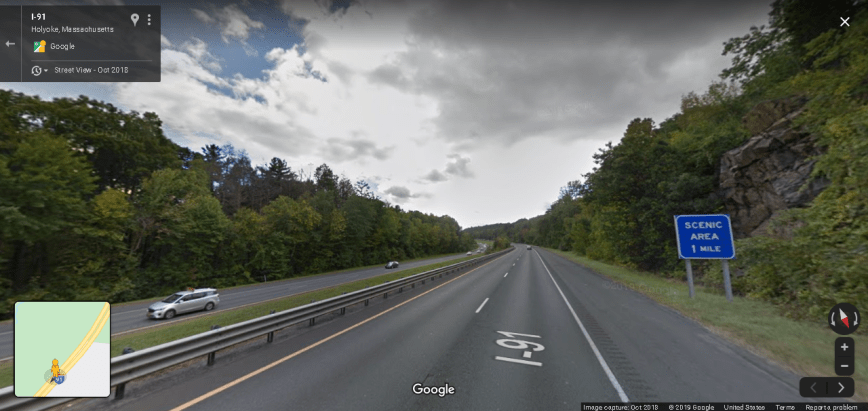
scenic area i mile

Scenic Area 1 mile (today on I-91)

The rest area was not the one listed in GCN’s 1976 New England Gay Guide . It attracted men from up and down the highway, as well as locals. A fourth of those arrested lived in Connecticut. One was from Vermont, another from Eastern Massachusetts. Three were from nearby Hampden County. Northampton’s Daily Hampshire Gazette printed the names and addresses of the five from Amherst, Florence, Hadley and Northampton, including two who lived together. While the age of the sixteen men charged ranged from twenty to sixty-two, most were in late thirties and early forties.

Springfield_Union_1978-10-24_16   Springfield (MA ) Union Oct. 24, 1978

Police justified the entrapment because seven weeks previously a man reported that he had been raped and robbed there by another man. Such victimization of men who cruised for anonymous sex (and who were unlikely to report crime to authorities), was so common that it was referred to in the gay subculture as “being rolled.”

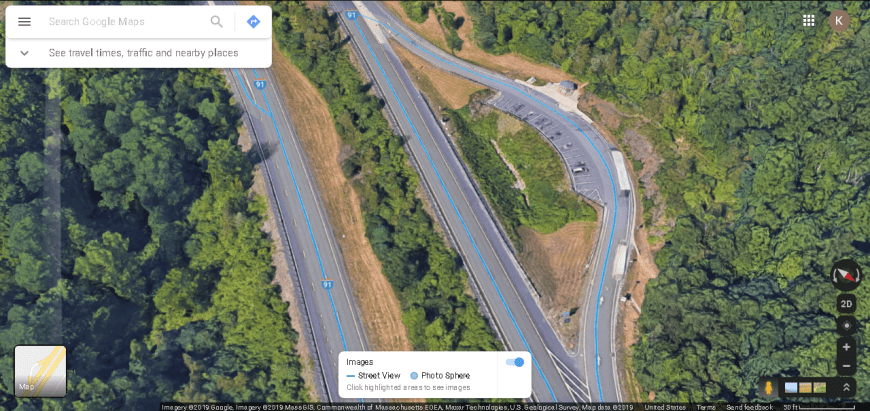
Rather than trying to solve the crime however, police focused on shutting down the sexual activity, which they characterized to the press as “homosexual attacks.” For two weekend evenings, Oct. 21-22, plainclothes police made themselves available for proposition at the rest area and then arrested anyone who approached them. The men were charged with “lascivious behavior,” “open and gross lewdness,” and/or, if there was any physical contact, “assault and battery.” In a follow-up article in the Springfield Union, the Captain of the local State Police said that the alleged homosexual activity was continuing in the rest area adjacent to Mount Tom in spite of the arrests, and that the state police undercover work there would continue until the situation [was] cleared up.

scenic area 2

Only one of the sixteen arrested, the man from Somerville, submitted to the facts of the case in the Holyoke District Court on Oct. 23 and was fined $125. All the others pled innocent and were given trial dates, or were given hearing dates to enter a plea. Their court dates were scattered over the coming month. It would be interesting to know the results of further hearings or trials but I could find  no later newspaper coverage . Holyoke District Court records are not digitized for this time. Does anyone know where the paper records are stored?

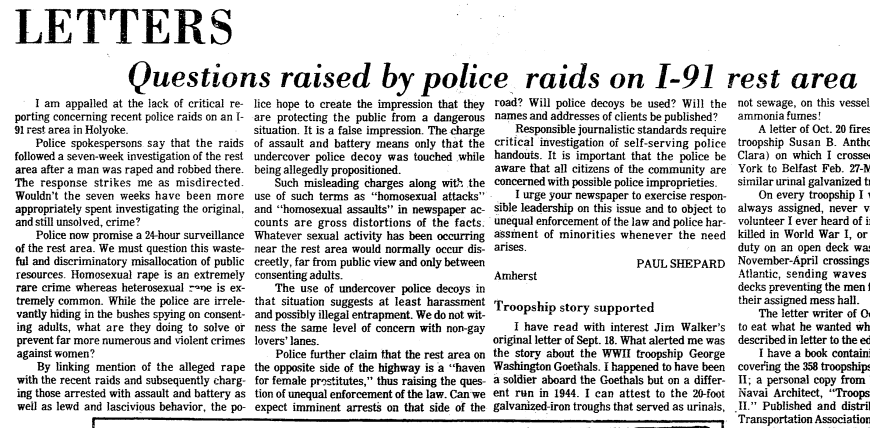
The press coverage of the arrests provoked a response from Valley gay men and their allies. Several were moved to write letters to the editors of local newspapers, including, I am told, the Valley Advocate and one printed in Springfield Union from Amherst resident Paul Shepard.

Springfield_Union_1978-11-01_15Springfield Union Nov. 1, 1978.

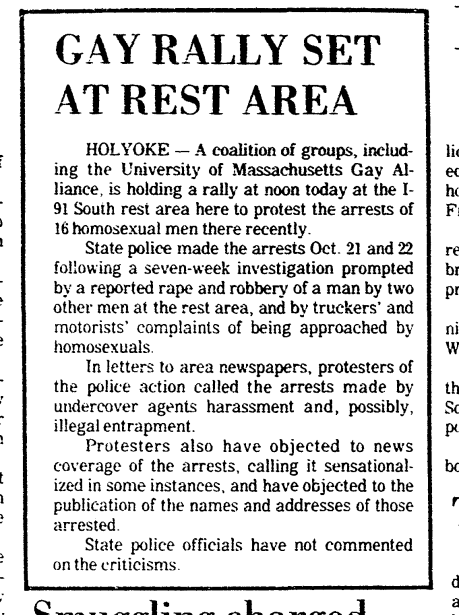
Two weeks after the arrests, Nov. 5, approximately fifty people protested police and media action by bringing signs and mimeographed handouts to the rest stop at midday, standing so they could be seen from I-91 as well as by those pulling into the rest area. Steve Trudel and at least one other gay man from Northampton were among the protesters. The UMass Gay Alliance was one of the organizing groups with members present.

Springfield_Union_1978-11-04_8

Springfield Union, Nov. 4, 1978

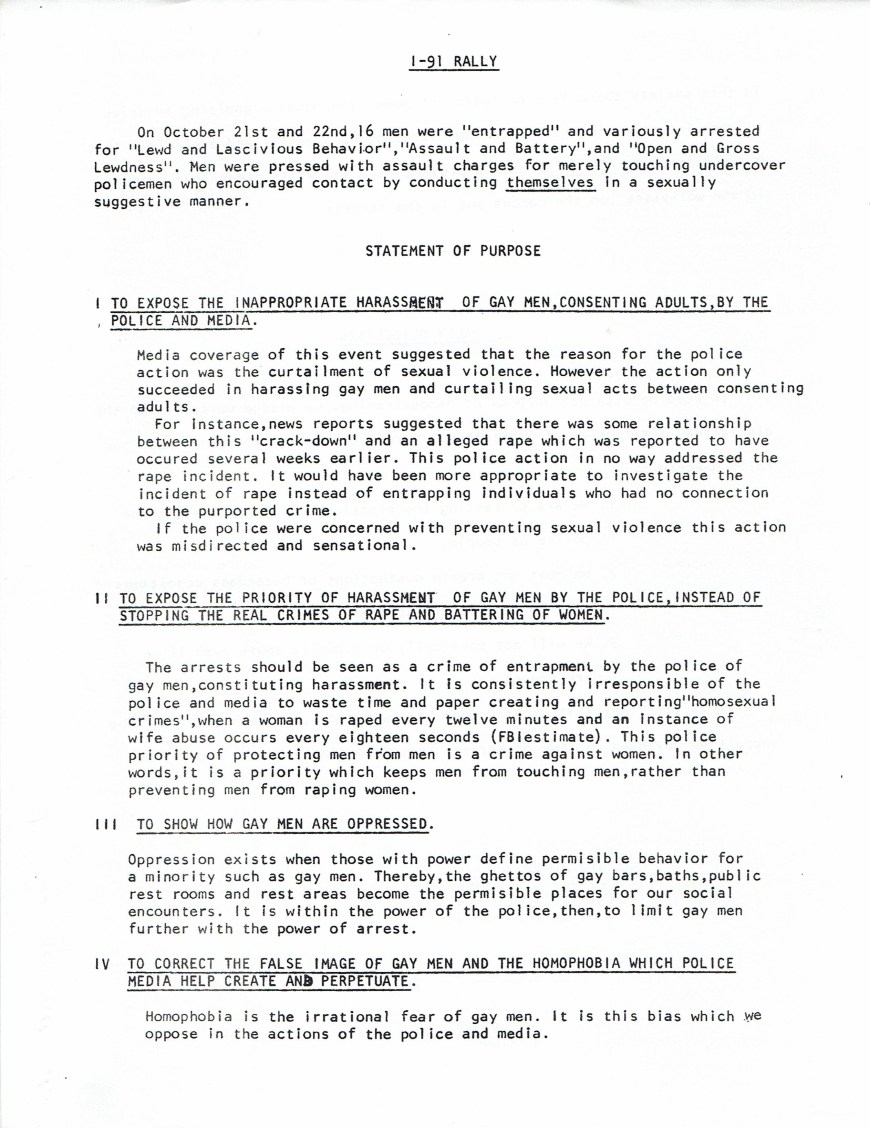
The purpose of the demonstration was to expose the harassment of gay men for adult consensual behavior; the waste of police resources which could better be used solving “real” crimes such as the rape and battery of women; and the general oppression of gay men. Demonstrators also wanted to correct the false image of gay men created by homophobic police and media.

nov 4 78 rally flyer_edited-1Flyer distributed Nov. 5, 1978, mimeograph one of two sides, courtesy Bambi Gauthier
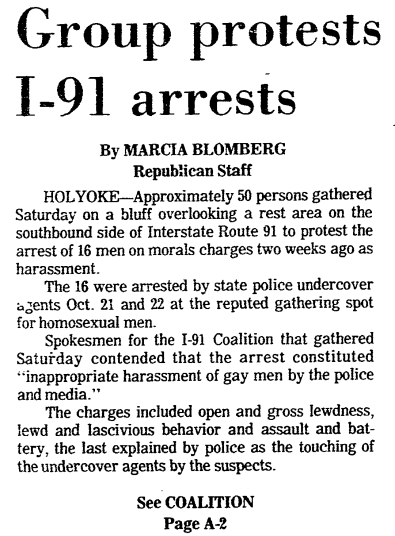
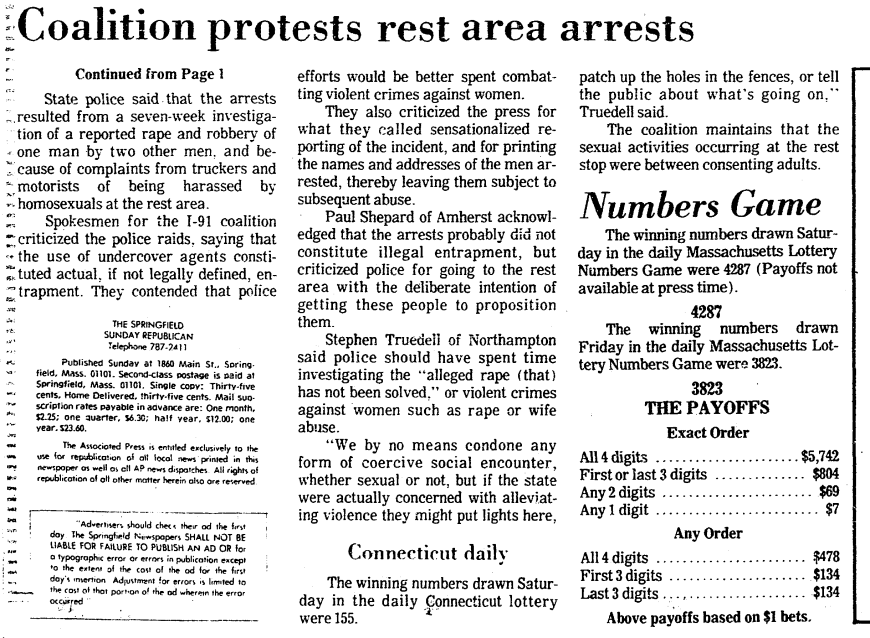
There were no hassles and at least one TV station filmed the demonstration. In an interesting aside, Steve recalls being interviewed at the demonstration by a Valley reporter who he recognized from other political events and who gave him “the creeps.” So Steve asked him if he had a history of doing undercover work. The reporter admitted he had previously worked for the government.

Springfield_Union_1978-11-05_1

Springfield_Union_1978-11-05_2Springfield Republican Nov. 4, 1978.

It was very radical analysis and action for the time. While there was no overt reply or statement made by the local governments or state police in response to the rally, I couldn’t find news records of further arrests at that scenic area or of that nature. So it appears that the outcry successfully stopped further entrapment of gay men.

scenic area 4

as seen today (2019), there are no holes in the fence and bushes and trees are cut back.

Steve remembers it as “the only exciting (pro-gay) political action at the time. It was difficult to do, to put oneself out there.”  Valley gay men with a political consciousness, it seemed to him, were few and far between in this decade. Just as many Northampton lesbians were energized working with feminist women, a few politicized gay men found support, albeit out of town, in other progressive groups.

Steve and Bill Starkweather were joined at the I-91 demo by members of a group they belonged to: a pro-feminist men’s action group formed at Hampshire College in 1978. This group referred to themselves as ”positively men”and continued until at least 2004. Steve’s realization that there was more to being gay than sex and dancing led him to demonstrate solidarity with other oppressed groups. In Northampton in 1978, he was among the group of men who provided care for children while the mothers participated  in the Valley’s first  Take Back the Night March  . He and others of the group of also attended the 1979 March on Washington for Lesbian and Gay Rights.

It would be a few more years before gay men in Northampton formed their own group and began working in coalition with the city’s lesbians.

In a post note: I found documents online indicating that at least ten of those arrested in 1978 are now deceased.  It is too late to ask them how that public outing in the form of being charged with crimes impacted their lives. Seven of the deceased had enough information in their death notices to indicate their marital status.  Three of them had wives and children while four did not. One of those bachelors was the “Beloved friend of Robert…, William…, Rudy…, Bruce…, Todd…, Jack…,[et al.]” And he had volunteered at a local AIDS support organization. Another of the unmarried men was a resigned Catholic priest charged with child sex abuse in 2002.

skyview scenic area

SOURCES:

__Trudel, Stephen. Phone interview and email correspondence. Sep. 20, Nov. 22, 2004.

__”16 men arrested in sex raid.” Springfield Union. Springfield MA.  Oct. 23. 1978.

__ “Five men from area charged in sex cases.” Daily Hampshire Gazette. Northampton MA. Oct 23, 1978.

__Horgan, Sean T. and Quinlan, Joseph. “16 arrested in sex raid at I-91 South rest area.” Massachusetts Daily Collegian. UMass Amherst. Oct 23, 1978.

__Perkins, Robert. “Cops to continue probe of highway rest area.” Springfield Union. Springfield MA. Oct. 24, 1978.

__Shepard, Paul. “Questions raised by police raids on I-91 rest area.” Letter to the Editor. Springfield Union. Springfield MA. Nov. 01, 1978.

__”Gay Rally set at Rest Area.” Springfield Union. Springfield MA. Nov. 04, 1978.

__Blomberg, Marcia. “Group protests I-91 arrests.” Springfield Republican. Springfield MA. Nov. 05, 1978.

__”Diocese of Burlington releases priest sexual abuse report, names.” Vermont Business Magazine. Aug. 22, 2019.

__thanks to Bambi Gauthier for bringing this story to my attention and providing copies of some documents and contacts to interview.