
The very first issue of mimeographed Dyke Doings, Sep/Oct 1976, carried the announcement that several lesbian-run businesses had opened in the rear of the building at 19 Hawley Street in Northampton. Calling themselves the Egg and (later added) Marigolths, the collectively-run spaces initially contained three businesses, as well as two craftswomyn studios, and a residence. Starting in July 1976, the all-Lesbian business ventures began sharing rent and utilities while operating independently. 
Dyke Doings Sep/Oct 1976
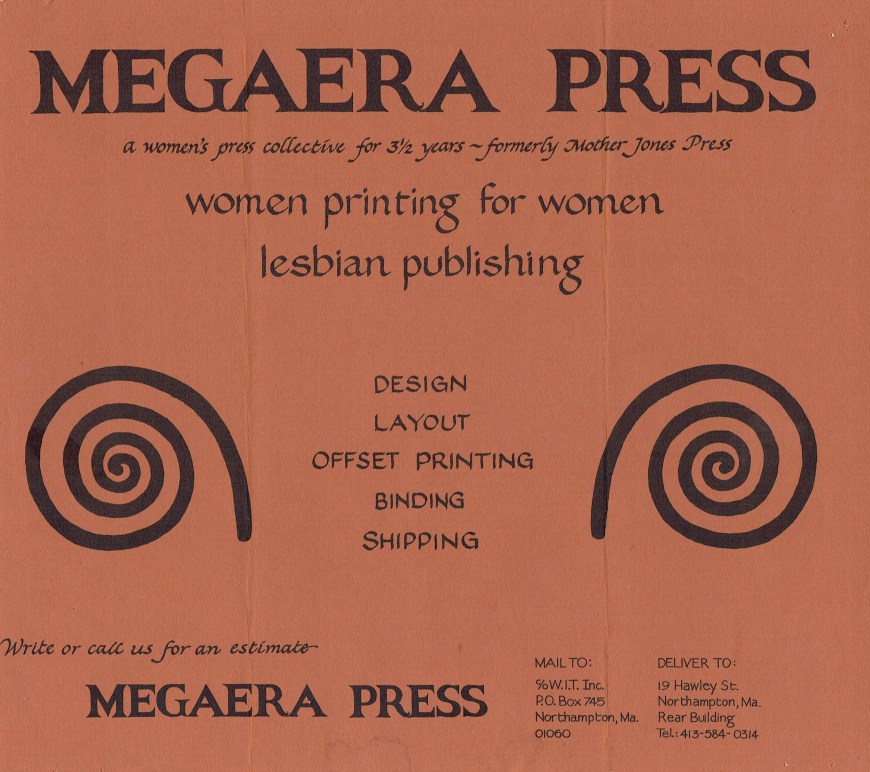
Mother Jones Press, a feminist offset press collective, had been renting space at 19 Hawley St. since its founding in 1972. The staff had dwindled to three, all Lesbians. In May 1976, they decided to close Mother Jones and open Megaera Press to publish Lesbian work. They also continued to print for women.
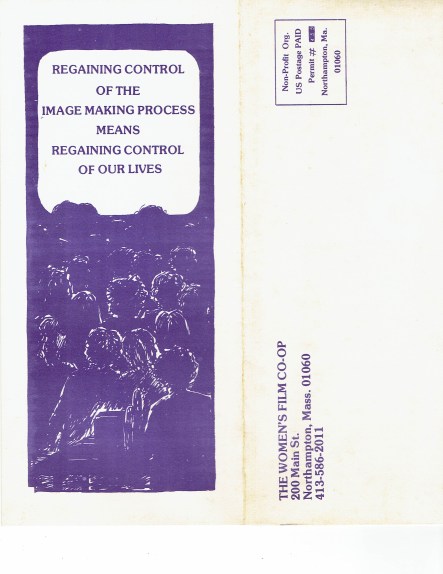
The Women’s Film Coop was also an older venture, started in 1972 when the Women’s Institute project at the Valley Women’s Center inherited eight films and a slideshow from New Haven feminist distributors. Operating out of a teeny space at VWC 200 Main St., the Film Coop had expanded their holdings of films available for rent and formed a non-profit corporation, Women’s Image Takeover (WIT), with their own PO address and mailing permit.
In 1973, the Coop had produced the first Valley (and perhaps New England) Women’s Film Festival, a week-long event at what became the Pleasant Street Theater in Northampton. The dearth of positive images at the time is demonstrated by the only films available to show at the Lesbian night: Maedchen in Uniform; the Children’s Hour; and several shorts. The shorts were Jan Oxenberg’s first film, Home Movie (1972), and maybe one by Barbara Hammer. The second edition of the Coop’s critical catalog of media that reflected the real experience of women included reviews of an increasing number of films just starting to be created by feminists and lesbians in the US.

1974 edition Cover art by Barbara Johnson
By the time it moved to Hawley Street in 1976, the Women’s Film Coop had dwindled to one Lesbian, Elana Dykewoman (later, Dykewomon), as minimally paid staff. In the new organization, Megaera Press was folded into WIT’s corporate umbrella, as was Dyke Doings, Old Lady Blue Jeans Distribution, and eventually Sweetcoming Bookstore.
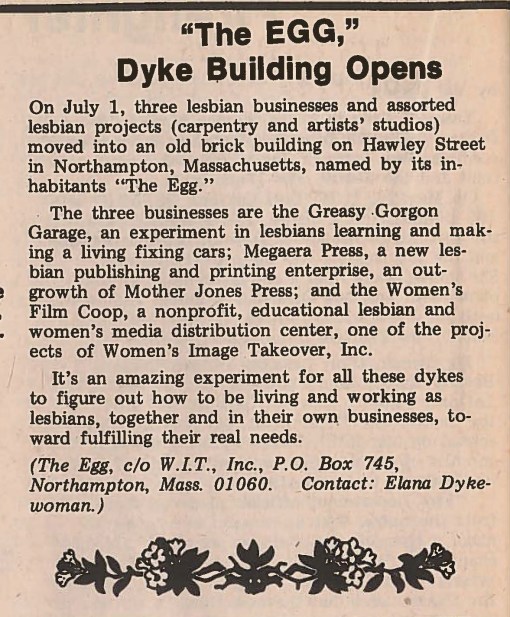
Lesbian Tide Sep/Oct 1976, courtesy of Sophia Smith Collection, Smith College
The newest of the three businesses in the Egg was the Greasy Gorgon Garage. Two Lesbians repaired women’s cars on a scaled-fee basis and assisted women wanting to work on their own vehicles. They planned to offer auto maintenance classes, with a larger goal of establishing a non-profit training center for women mechanics. Also new were the two studios, one of which was occupied by a Lesbian carpenter/cabinetmaker and the other by a Lesbian jeweler/seamstress.

Ad Dyke Doings Sep/Oct 1976
Megaera Press’s first Lesbian publication came out in September 1976. It was Elana Dykewoman’s [Dykewomon] They Will Know Me By My Teeth: Stories and Poems of Lesbian Struggle, Celebration, And Survival.
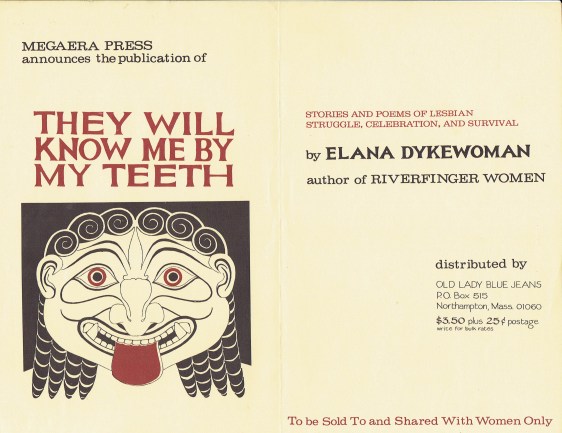
cover by Laura K Vera, used by permission
It stated in the volume that “This book was printed, financed, typed, corrected and bound entirely by lesbians.” The 3,000 copies were hand-collated, Elana recalled in a 2001 interview. It also stated on the cover: “To Be Sold To And Shared With Women Only.” While anyone may now get used copies through internet used bookstores, in the 70s before the feminist bookstores began, Old Lady Blue Jeans was the sole distributor of the book.
The local one-womyn enterprise was already distributing other art by Valley Lesbians: notecards by (now) anonymous; Linda Shear’s LP album of original songs “A Lesbian Portrait;” and Great Hera’s (Kaymarion’s) Incunabula prints-to-color. The old lady of Old Lady Blues Jeans took these items, a brochure, and Elana’s book to Lesbian events to sell. Mail orders were solicited through advertisements in the increasing number of national Lesbian publications coming into being at that time . OLBJ eventually circulated hundreds of Lesbian-made products, though the owner never made a living from this work.
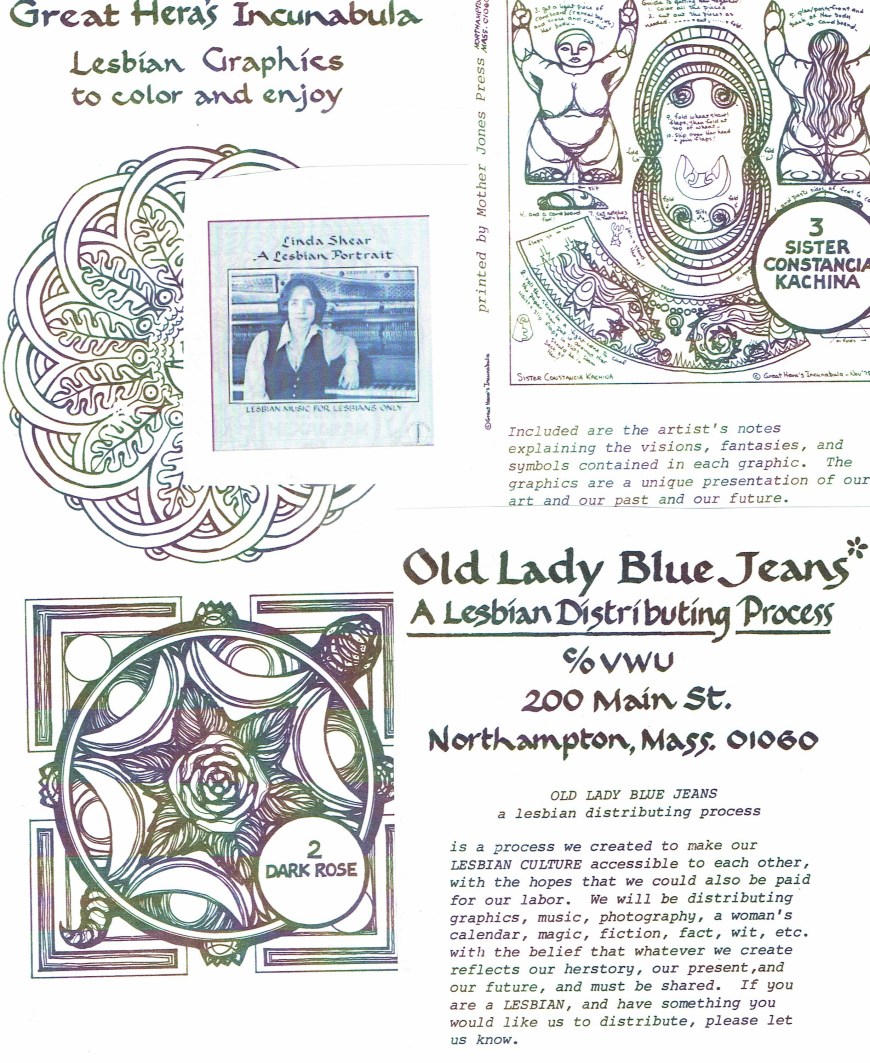
Collage of parts of OLBG catalog. Linda Shear photo used by permission. Great Hera’s Incunabula by Kaymarion [Raymond]
Megaera Press’s second, and final, Lesbian publication was a collection of local Lesbian creations. Visual art, music, and writing by forty womyn were included in The Rock: a Collection of Lesbian Expressions. Decisions on what to include and the physical process of producing it were done collectively by the contributors and others from the Lesbian community. A publication party was held April 4, 1977 at the Common Womon Club to premiere this for-wimmin-only book and celebrate its issuance. On a personal note, it included a drawing of me by a Green St. tenant; my fourth and last issue of Great Hera’s Incunabula, a woodcut print; and a poem by someone else that I think referred to me entitled, “Horizontal Hostility.”
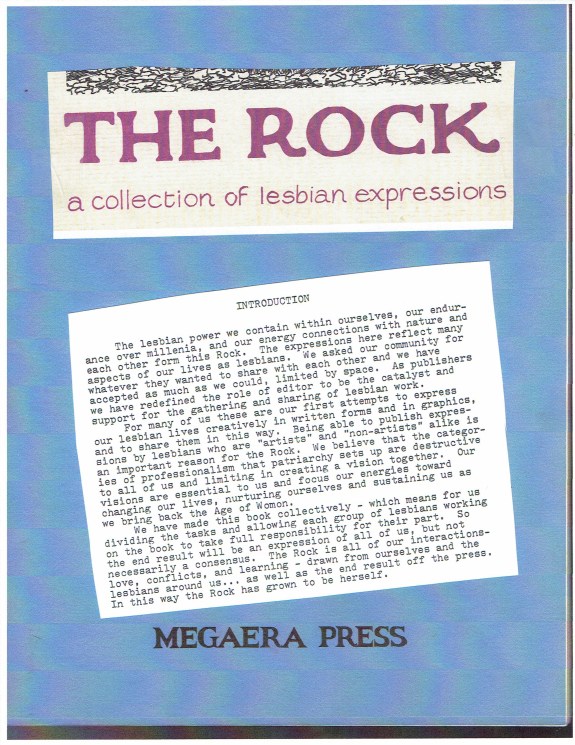
Collage of the more public bits of the Rock
The Dec.1976 Dyke Doings contained an announcement from Elana Dykewomon that she was planning to leave the Valley the next summer and was looking for someone to take over the Women’s Film Coop. By mid-1977, no one had volunteered for this, so the films and slides being distributed by the Coop were returned to their makers and the business was closed. Megaera Press sold their offset press and closed that summer as well. The papers for the umbrella non-profit corporation Women’s Image Takeover were handed over to a local Lesbian volunteer.
While the rest of the Egg collective withered after a year, the Greasy Gorgon Garage (Triple G) had expanded to three and a half womyn mechanics and two apprentices. Twice weekly repair classes were being offered. They found new space, a “real” garage, for their business in nearby Hatfield in August 1977. At the end of the year, according to their notice in Lesbian Connections, they were seeking funds to buy the rented building. I find no record of their later history. Does anyone know?
 LC Dec 77
The Egg only lasted a year and the collective members became dispersed across the country. Some, Elana recalls, moved to Minneapolis where there was a sobriety community. She herself initially wound up in Oregon via Springfield MA and Florida, and later settled in Oakland CA where she continued to write and circulate work by Lesbians. Raelyn Gallina fetched up in California where she established herself in the Lesbian and S/M communities as a nationally known pioneering practitioner of piercing and scarification, particularly for women. Elana estimated that by 1978-79, all the dykes of the Egg had left the area.
SOURCES:
__[Raymond], Kaymarion and Letalien, Jacqueline, editors. The Valley Women’s Movement: A Herstorical Chronology 1968-1978. Ceres Inc. Northampton MA. 1979. http://vwhc.org/timeline.html
__ Dyke Doings. Northampton MA. Sep/Oct, Dec 1976.
__ Women’s Film Coop. Catalogs 1972 and 1974. Northampton MA.
__ “The Egg: Dyke Building Opens.” Lesbian Tide. Sep/Oct 1976. Courtesy of the Sophia Smith Collection, Smith College. Northampton MA.
__ Dykewomon, Elana. Interview by Tryna Hope. Aug. 20, 2001. Valley Women’s History Collaboration Collection. UMass Special Collections and Archives. Amherst MA.
More information at https://www.dykewomon.org/
__Old Lady Blue Jeans. Catalog. Undated, probably 1976. Northampton MA.
__The Rock: a Collection of Lesbian Expressions. Megaera Press. 1977. Northampton MA.
__ “GREASY GORGON GARAGE.” Lesbian Connection. Dec. 1977.
__Vale, V and Juno, Andrea editors. Interview with Raelyn Gallina. Included in Modern Primitives. RE/Search 1989.
__Johnson, Barbara. http://barbarajohnson.com/index.htm
__Shear, Linda. Family of Womyn https://www.youtube.com/watch?v=zLM-xZnTsPA.
More about the album https://queermusicheritage.com/oct2001b.html
__Gallina, Raelyn. Interview https://www.youtube.com/watch?v=bZRA0JmSIpQ
Obituary https://infinitebody.com/blogs/news/r-i-p-raelyn-gallina
__ Review and view Maedchen in Uniform https://www.afterellen.com/movies/79116-review-of-mdchen-in-uniform-1958 Link to view https://www.youtube.com/watch?v=VJDEvwftR94
__ Childrens Hour https://www.rottentomatoes.com/m/childrens_hour
__ Jan Oxenberg https://www.ejumpcut.org/archive/onlinessays/JC24-25folder/JanOxenberg.html
__Barbara Hammer the early films http://barbarahammer.com/films/barbara-hammer-the-early-films-1968-72/



 From Wicked To Wedded